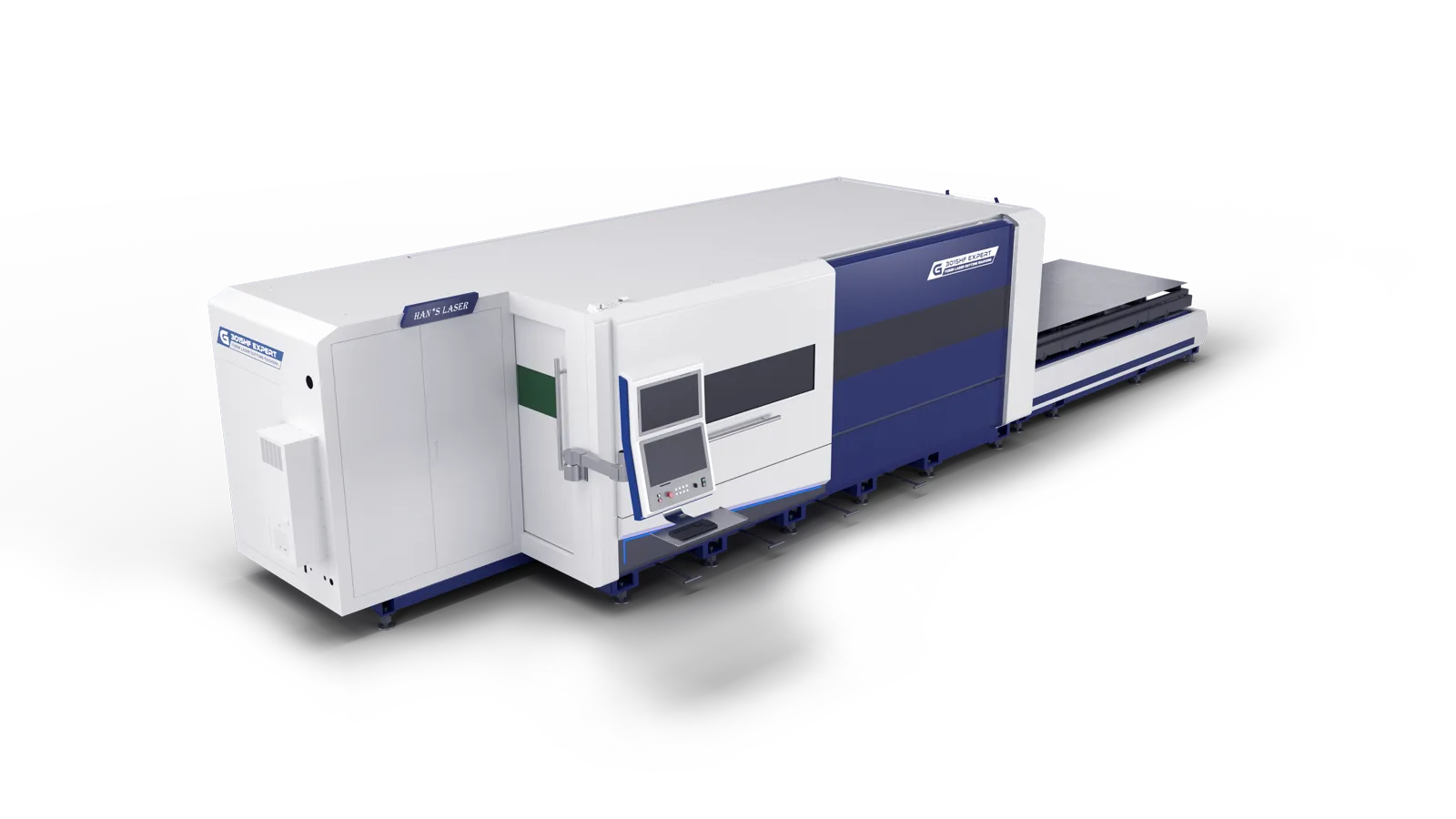
Fiber laser cutting capacity is a combination of material, thickness, laser power, cutting head and assist gas. For a Canadian shop comparing Han’s Laser sheet cutters, a maximum-thickness headline is only the beginning. The useful question is whether the quoted configuration repeatedly produces your required parts at an acceptable finished-part cost.
Use this guide to compare cutting applications and prepare a machine-specific review. Values below are metric; inch equivalents are rounded, not stock-size designations.
Han’s 20 kW cutting thickness by material and assist gas
The thicknesses below are configuration-dependent examples, not guaranteed limits for every Han’s machine, alloy or contour. Confirm the cutting chart and sample results for your quoted equipment. Unconfirmed gas-specific values need an application review.
| Material | Assist gas | Thickness example |
|---|---|---|
| Carbon steel | Oxygen (O₂) | 50 mm (1.97 in) |
| Carbon steel | Air | 20 mm (0.79 in) |
| Carbon steel | Nitrogen (N₂) | 20 mm (0.79 in) |
| Stainless steel | Nitrogen (N₂) | 16–40 mm (0.63–1.57 in) examples |
| Stainless steel | Air | Gas-specific thickness not established |
| Aluminum / aluminum alloys | Nitrogen or air; exact gas not paired to the thickness claim | 18 mm (0.71 in) or more reported, conditional |
| Copper | Gas not specified for the thickness claim | 18–20 mm (0.71–0.79 in), gas-specific capacity unconfirmed |
| Brass / coated or galvanized sheet | Confirm the approved gas | No gas-specific capacity established here |
Severance, piercing and repeatable production are different acceptance questions. Ask whether a sample began from an edge or pierced inside the plate, whether small holes and tight corners were included, and whether the cut met the agreed taper, roughness and dross requirements. A successful straight cut does not answer all of those questions.
Oxygen, nitrogen and compressed air: what changes?
| Gas | Process and likely use | What to check on your part |
|---|---|---|
| Oxygen | Reactive cutting: oxidation contributes heat. Commonly evaluated for carbon steel, particularly thicker plate. | Inspect oxide on the edge and any preparation needed before coating or welding. |
| Nitrogen | Fusion cutting: gas expels molten metal while limiting oxidation. Commonly evaluated for stainless steel and aluminum. | Confirm the required edge finish and gas supply capacity; do not assume zero dross on every alloy. |
| Compressed air | Contains both nitrogen and oxygen. Air cutting can be evaluated for carbon-steel applications. | Compare edge oxidation and downstream work. Include compressor, drying, filtration, electricity and maintenance in the budget. |
| Controlled mixed gas | A selected nitrogen/oxygen blend is another process route; it is not the same as simply choosing compressed air. | Request the approved mixture and equipment configuration, then compare accepted parts under matching conditions. |
What is the Han’s Laser Mix-M device for 20 kW-plus machines?
Han’s describes Mix-M as an optional gas-mixing cabinet/process for lasers of at least 20 kW, targeting 10–40 mm carbon steel. Its stated purpose is to improve cut-face and corner dross, taper and roughness. That describes the intended application; it does not establish a guaranteed result at every power within that range.
Confirm Mix-M compatibility for the exact machine, laser source, cutting head and controller. The 20 kW-plus process description does not establish compatibility with lower-power equipment.
MixGas and Mix-M applications
MixGas combines nitrogen and oxygen. The examples below distinguish mixed-gas cutting from the named Mix-M process. Confirm the cabinet, process and accessories included in your quotation.
| Power | Material / thickness | Process |
|---|---|---|
| 20 kW | Carbon steel: 20 mm (0.79 in) | MixGas: nitrogen/oxygen blend. |
| 30 kW | Carbon steel: 30 mm (1.18 in) | MixGas: nitrogen/oxygen blend. |
| 40 kW | Carbon steel: 25–35 mm (0.98–1.38 in) | Mix-M carbon-steel application range. |
| 40 kW | Stainless steel: up to 25 mm (0.98 in) | Air cutting; not a stainless Mix-M rating. |
| 50 kW | Carbon steel: 40 mm (1.57 in) | Mix-M carbon-steel batch-cutting example. |
Ask Rise Tek to confirm the Mix-M inlet pressure, flow, mixture ratio and installation requirements for the exact configuration. Use its approved process documentation rather than another gas-mixer supplier’s settings.
What to include in a Mix-M quotation
- Named cabinet and machine configuration, supported materials and power range.
- Required gas supplies, purity, flow and connection requirements from the manufacturer.
- Control integration, approved process database and responsibility for commissioning.
- Sample acceptance criteria and the supplied versus customer-provided equipment.
- Measured gas consumption and complete cycle time on your parts, with the comparison baseline identified.
Build a capacity chart for your own production
Start with the jobs that account for most of your cutting hours. Include a typical job, a thick-plate job and a difficult geometry. For each, record the alloy, actual thickness, surface condition, assist gas and exact machine configuration.
- Agree the result: dimensions, holes, taper, edge finish and acceptable dross.
- Run representative parts: include pierces, corners and repeated cuts rather than only a straight sample.
- Record the full cycle: piercing, cutting, handling, inspection and finishing.
- Compare the cost: gas, electricity, consumables and downstream labour per accepted part.
- Keep the sample records: sample ID, photographs, measured results and the applicable process-chart revision.
Download the blank capacity and assist-gas review worksheet. Send it with your drawings and delivery location for a Rise Tek application and equipment review.
Check these out
Discuss the power, cutting head, gas system and sample acceptance for your material mix with Rise Tek.
Frequently asked questions
How thick can a Han’s 20 kW fiber laser cut?
Configuration-dependent examples include 50 mm carbon steel with oxygen, 20 mm carbon steel with air or nitrogen, and 16–40 mm stainless steel with nitrogen. Confirm the machine-specific chart and sample results; these are not guaranteed limits for every Han’s machine.
Does Mix-M mean every 20 kW laser can cut 40 mm carbon steel?
No. Han’s describes Mix-M as an optional gas-mixing process for 20 kW-plus lasers and 10–40 mm carbon steel. That range spans configurations; confirm the approved chart and sample results for the quoted machine and power.
Can I use air instead of nitrogen for sheet cutting?
Air can be an option for sheet cutting, but it is not interchangeable with nitrogen for every part. Confirm edge oxidation, finishing requirements, gas quality and the machine-specific cutting chart before comparing costs.
Is MixGas the same thing as the Mix-M device?
MixGas is a nitrogen-and-oxygen mixture. Mix-M is Han’s named optional gas-mixing device/process. Confirm its ratio, pressure and installation requirements for the exact configuration; do not assume one specification applies to every machine.