Fiber laser technology has become an essential tool in modern industrial manufacturing — reshaping cost structures, quality standards, and production capabilities across aerospace, automotive, construction, renewable energy, and general fabrication. Understanding how this technology evolved, what it enables today, and where the Canadian market stands is useful context for any shop evaluating a capital equipment decision.
The Evolution of Fiber Laser Technology
Fiber laser technology originated in telecommunications research in the 1960s — the same optical fiber amplification principles that enable global internet infrastructure were later adapted for high-power industrial applications. The transition from kilowatt-range research tools to 20kW+ production machines happened rapidly through the 2010s, driven primarily by improvements in laser diode brightness and fiber coupling efficiency.
The inflection point for industrial adoption was roughly 2012–2015, when fiber laser machines crossed the performance and price threshold that made them viable replacements for CO₂ laser — at the time the gold standard for precision metal cutting. By 2020, fiber laser had displaced CO₂ as the dominant new installation technology globally. As of 2023, fiber laser accounts for over 70% of all new industrial laser cutting machine installations worldwide.
Sheet Metal Cutting: The Core Application
Fiber laser sheet metal cutting is the highest-volume industrial laser application globally. The five primary advantages that define its impact on manufacturing economics:
- Speed: Fiber laser cuts thin sheet metal faster than any competing technology. At 2mm stainless steel, a 6kW fiber laser achieves 20–30 m/min — compared to 6–10 m/min for an equivalent CO₂ machine.
- Accuracy: Positioning accuracy of ±0.05mm and kerf widths of 0.1–0.2mm enable complex geometry that was previously only achievable by waterjet or EDM.
- Material versatility: A single machine handles mild steel, stainless, aluminum, copper, brass, and titanium — eliminating the need for dedicated machines per material.
- Reduced waste: Narrow kerf and accurate nesting software improves material utilization by 8–15% versus older cutting technologies.
- Minimal maintenance: No mirrors, no laser gas, no resonator maintenance — the technology is fundamentally simpler to own than CO₂.
High-Power Applications: Thick Plate and Structural Steel
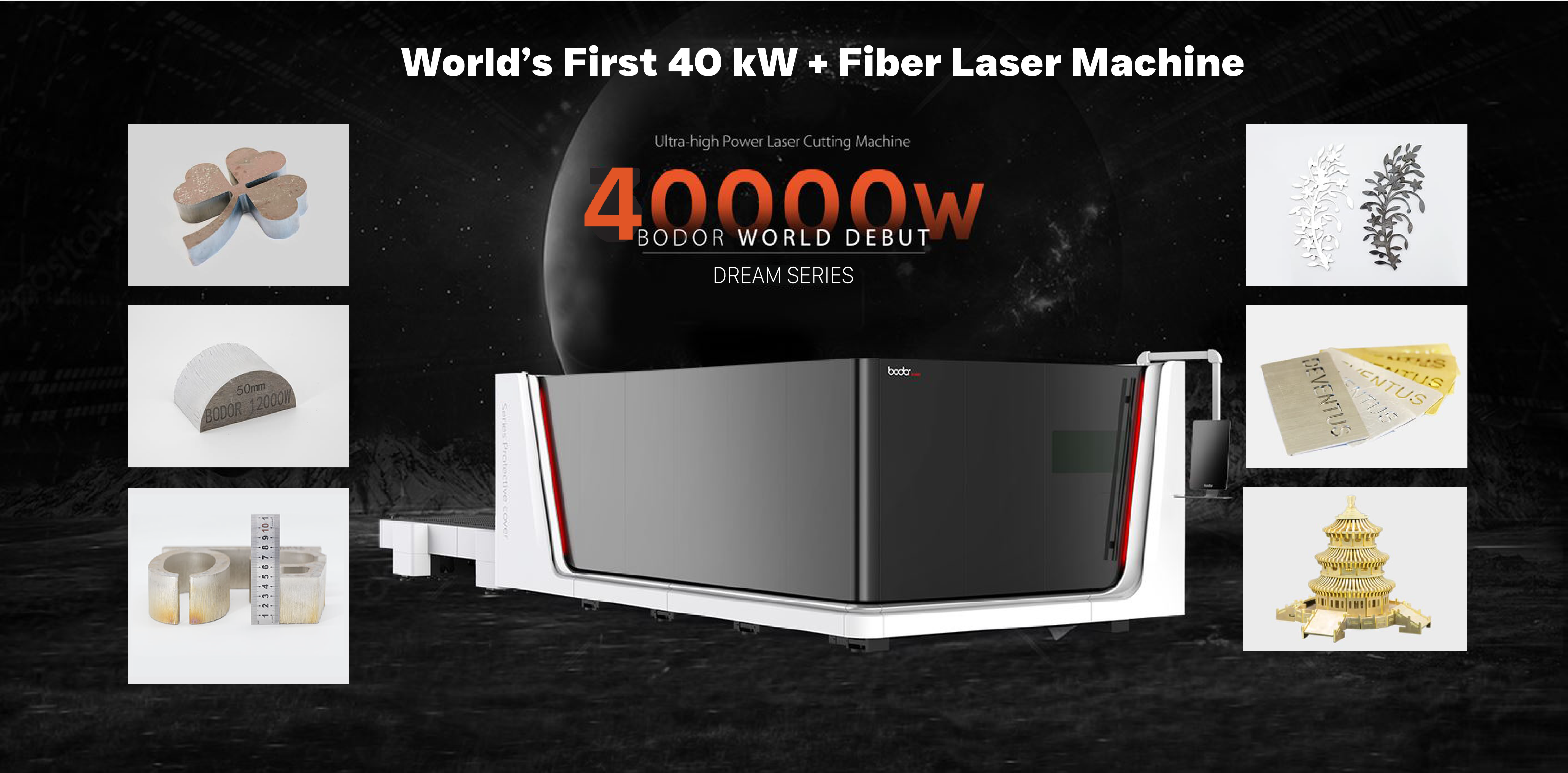
High-power fiber laser machines (12kW–40kW+) have opened a new competitive front against plasma cutting in structural steel fabrication. The Bodor 40kW machine shown above represents the current upper end of commercially available production machines — capable of cutting mild steel plate up to 80mm thick with fiber laser edge quality.
Industries driving high-power fiber laser adoption:
- Aerospace and defense: Thick aluminum and titanium structural components with tight tolerances
- Shipbuilding: Large-format structural steel cutting with minimal post-processing
- Construction and heavy equipment: Structural frames, heavy plates, and custom fabricated components
- Renewable energy: Wind turbine towers and solar racking structures require the combination of scale and precision that high-power fiber laser provides
The Canadian fiber laser market is growing rapidly, driven by government manufacturing investment programs, strong automotive sector demand in Ontario, energy sector fabrication in Alberta, and infrastructure investment nationally. Rise Tek has been the leading Canadian fiber laser distributor for over 20 years, with installations across every province.
Choosing the Best Fiber Laser for Your Application
Five selection criteria that matter most for Canadian fabricators:
- Cutting capability: Match power level to your thickest common material, not your thickest occasional piece
- Power output: 3–6kW for most job shops; 8–12kW for production environments; 15kW+ for structural steel
- Accuracy specifications: Positioning accuracy ±0.05mm is standard; verify repeatability specs for tight-tolerance work
- Software and control: CypCut, DELEM, and MetaCAM all offer strong ecosystems — choose based on your existing software infrastructure
- Service and support: Canadian parts inventory and local certified technicians matter more than brand logo after the sale
The Future of Fiber Laser in Canada
The trajectory is clear. Fiber laser machines are getting more powerful, more automated, and less expensive per unit of capability. The 20kW machines that were exotic in 2020 are standard catalogue items in 2023. The shops that invest now will have a cost and quality advantage over shops that defer — an advantage that compounds as automation capabilities make two-shift and lights-out production increasingly accessible.
The question is no longer whether to adopt fiber laser technology — it's which machine, which power level, and what automation level makes sense for your production volume and capital budget.