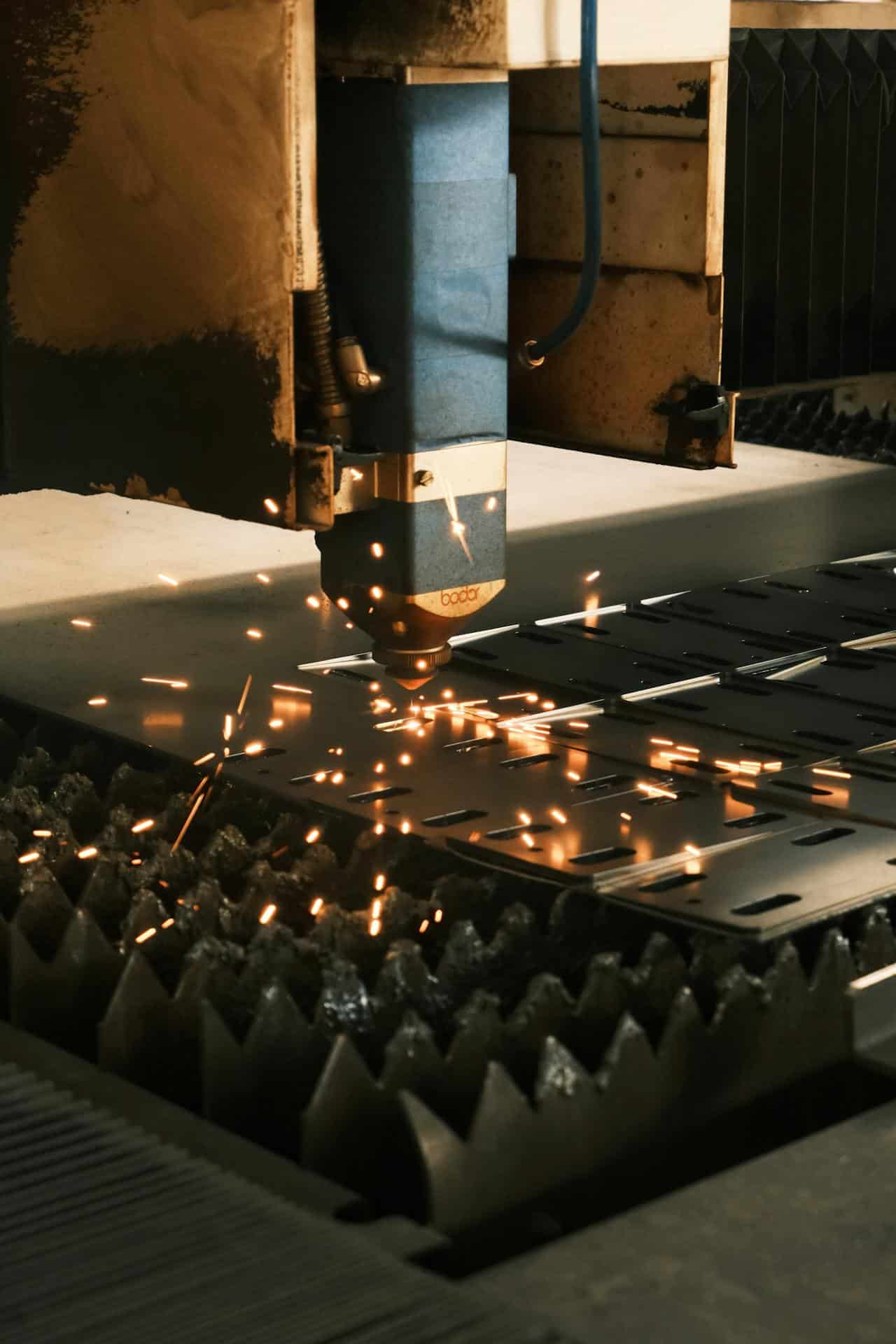
The question "is fiber laser worth it?" usually comes from shops evaluating their first laser purchase, or from CO₂ laser owners considering an upgrade. The honest answer depends on what you're cutting, how much you're cutting, and what you're comparing against. This article works through the technical and financial case — including the real disadvantages — so you can make an informed decision.
How Fiber Laser Technology Works
A fiber laser generates its cutting beam using rare-earth-doped (ytterbium) optical fiber as the gain medium. Laser diodes inject photons into the fiber, which amplifies them and emits a tightly focused, high-power beam at 1.06 µm wavelength. Unlike CO₂ lasers, there are no mirrors to align and no gas resonator to maintain — the beam is delivered directly through fiber-optic cable to the cutting head.
Key technical components:
- Laser source: Ytterbium-doped fiber amplifier — rated 100,000+ hours service life
- Delivery fiber: Process fiber carrying beam from source to head — the most fragile component, avoid kinking
- Cutting head: Contains the collimating lens, focus lens, and nozzle assembly — the primary consumable system
- CNC controller: Manages all axes, power, gas, and safety systems
Fiber Laser vs. CO₂: Technical Comparison
| Specification | Fiber Laser | CO₂ Laser |
|---|---|---|
| Wavelength | 1.06 µm | 10.6 µm |
| Wall-plug efficiency | 30–50% | 5–10% |
| Power consumption (6kW out) | 18–22 kW | 40–60 kW |
| Maintenance (annual) | <$5,000 CAD | $20,000–$50,000 CAD |
| Thin sheet speed (3mm steel) | 18–25 m/min | 6–10 m/min |
| Thick plate (25mm+) | Excellent (high power) | Limited |
| Uptime | ~98% | 80–90% |
Advantages of Fiber Laser Cutting
Faster Cutting Speeds
On thin to medium gauge metals (under 10mm), fiber laser cuts 2–3x faster than equivalent CO₂ power. At 3mm mild steel, a 6kW fiber laser achieves 18–25 m/min versus 6–10 m/min for a 6kW CO₂. This speed advantage directly translates to more parts per shift at the same staffing level.
Lower Operating Costs
Energy consumption is 60–70% lower than CO₂. Annual maintenance is under $5,000 CAD versus $20,000–$50,000 for CO₂ (no mirrors, no gas, no resonator maintenance). Over a 5-year horizon, the operating cost savings for most shops exceed $100,000 CAD.
Higher Precision
The shorter wavelength (1.06 µm vs. 10.6 µm) produces a smaller focused spot size — resulting in a narrower kerf (0.1–0.2mm versus 0.3–0.5mm for CO₂) and a smaller heat-affected zone. This reduces material waste and improves edge quality on precision parts.
Honest Assessment: Disadvantages and Limitations
High Initial Investment
Entry-level fiber laser machines start at $80,000 CAD; production-grade machines are $150,000–$350,000. This is a significant capital commitment for small shops. The ROI math works at production volumes — it doesn't work for shops cutting one or two hours per day.
Reflective Metal Challenges
Cutting highly reflective metals (copper, brass, uncoated aluminum) requires anti-reflection features in the cutting head and careful parameter management. Standard fiber laser machines can be damaged by back-reflection when cutting these materials without the appropriate heads and parameters. Confirm capability with your supplier before committing to these materials.
Thick Plate Edge Quality
Above 20mm mild steel, fiber laser edge quality on the lower portion of the cut can be rougher than plasma — a phenomenon called "striations" caused by the melt dynamics at thick plate. High-power machines (12kW+) with optimized parameters largely address this, but it is worth verifying on your specific material before purchase.
For shops regularly cutting conductive metals in the 1–25mm range, at any meaningful production volume, fiber laser delivers positive ROI. The break-even versus CO₂ is typically 1–3 years. The break-even versus plasma depends on edge quality requirements and material thickness mix. Not worth it for non-metal cutting or very low-volume operations.
ROI Analysis Summary
- Energy savings vs. CO₂: $7,000–$11,000/year per machine (single shift)
- Maintenance savings vs. CO₂: $15,000–$45,000/year
- Productivity increase vs. CO₂ on thin sheet: 40–60% more parts per shift
- Typical ROI on upgrade from CO₂: 12–24 months
- Typical ROI on first laser purchase: 18–36 months
The fiber laser ROI case is well-established. The real question is not whether the technology pays — it's whether your volume justifies the capital commitment and whether you have the right service network to keep the machine running.