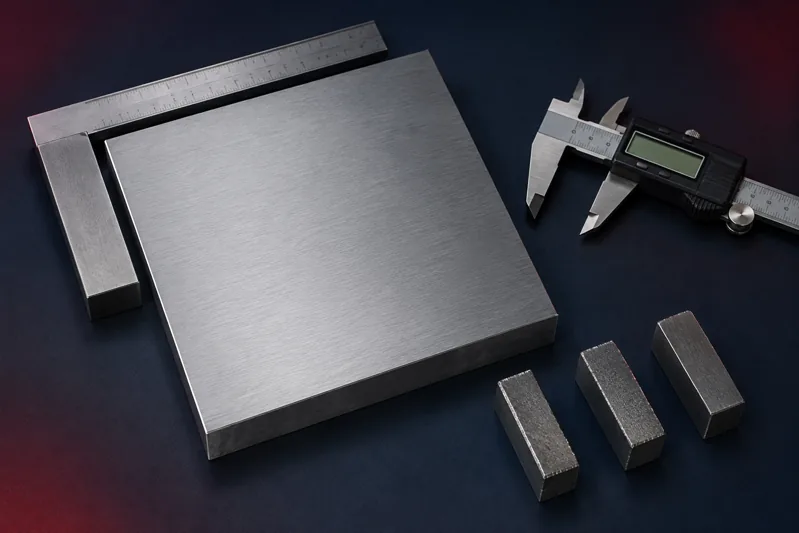
A useful fiber laser sample-cut evaluation tests the work your shop will actually produce. Give each supplier the same drawing revision, material specification and acceptance criteria, then compare inspected parts and the complete job cycle. A clean demonstration part is a starting point, not proof that a machine will meet every production requirement.
This guide provides a buyer's scorecard. It does not set universal tolerances or replace a machine's agreed acceptance test. Your drawing, customer requirements and supplier's written scope determine what counts as an acceptable result.
Build a small, representative test package
Choose a routine repeat job, a part with demanding features and a job near the upper end of your normal thickness range. The routine job shows everyday economics; the difficult geometry tests a real constraint. A maximum-thickness demonstration has limited value if most of your revenue comes from thin sheet.
Supply the part file and dimensioned drawing together. Record the revision, material grade, thickness, surface condition, quantity and any finish requirement. Identify critical holes, slots, mating edges or cosmetic faces. If you cannot disclose a customer drawing, prepare a representative test geometry you are authorized to share.
Ask the supplier to document the exact machine configuration and whether it matches the quote. Keep the test material and gas conditions comparable. If a supplier changes the process to achieve a better result, record the change and its cost implications rather than discarding useful information.
Agree on the scorecard before the demonstration
| Check | Evidence to record |
|---|---|
| Dimensions | Drawing requirement, measured result, inspection method and part identification. |
| Edge condition | Photos of both faces and cut edges; burr, dross or other features relevant to the next operation. |
| Fit and downstream work | Assembly or finishing checks required for the actual job. |
| Repeatability | Results from several parts and positions in the sheet, with sampling agreed in advance. |
| Job time | Defined start/end points for programming, setup, cutting, handling and finishing. |
| Production conditions | Configuration, material, gas and any special preparation or manual intervention. |
Do not reduce a failed critical dimension to a minor point in an overall score. Identify mandatory acceptance criteria separately from preferences. A part that cannot fit its assembly is not made acceptable by an attractive cycle time.
Inspect the part beyond its top surface
Check the features that control assembly using appropriate inspection equipment and an agreed method. Examine the underside as well as the visible face. Retain sample identifiers so photos, measurements and timing records refer to the same run.
A visual comparison cannot establish every surface or dimensional requirement. Where roughness, geometry or another measured property matters, agree on how it will be assessed. TRUMPF's laser-cutting overview shows different application examples and edge results; those examples are useful context, not acceptance limits for your machine or drawing.
Ask what happened to the part before it was presented: brushing, grinding, washing or another finishing operation may be entirely reasonable, but its labour and equipment belong in the comparison. A useful demonstration makes that work visible.
Measure the complete production cycle
Record laser-on time separately from the time needed to turn a released drawing and sheet into accepted parts. Include setup and handling where they apply, and distinguish one-time programming from repeat-batch work. Note which steps overlap and which require an operator's attention.
Count accepted parts as well as attempted parts. If a trial needs rework, preserve the time and result instead of reporting only the best piece. Use the cost-per-finished-part worksheet to compare the consequence of different yields and finishing needs.
Turn the sample result into a clear buying decision
Ask the supplier to explain any gap between the sample conditions and your planned installation. Record unresolved requirements in the quote comparison and agree on the next test or clarification. Keep the samples, files and measurement records with the purchasing decision.
Download the blank sample-cut scorecard. Use one copy per test condition. It is a record sheet, not an automatic pass/fail tool.
Should every supplier cut the same part?
Use the same baseline requirements so the results can be compared. Record proposed alternatives separately, including any difference in finishing or operating cost.
Can a sample guarantee future production?
No. It is evidence under recorded conditions. Define the equipment, commissioning and acceptance responsibilities in the written machine quote, and plan the site requirements for the selected configuration.