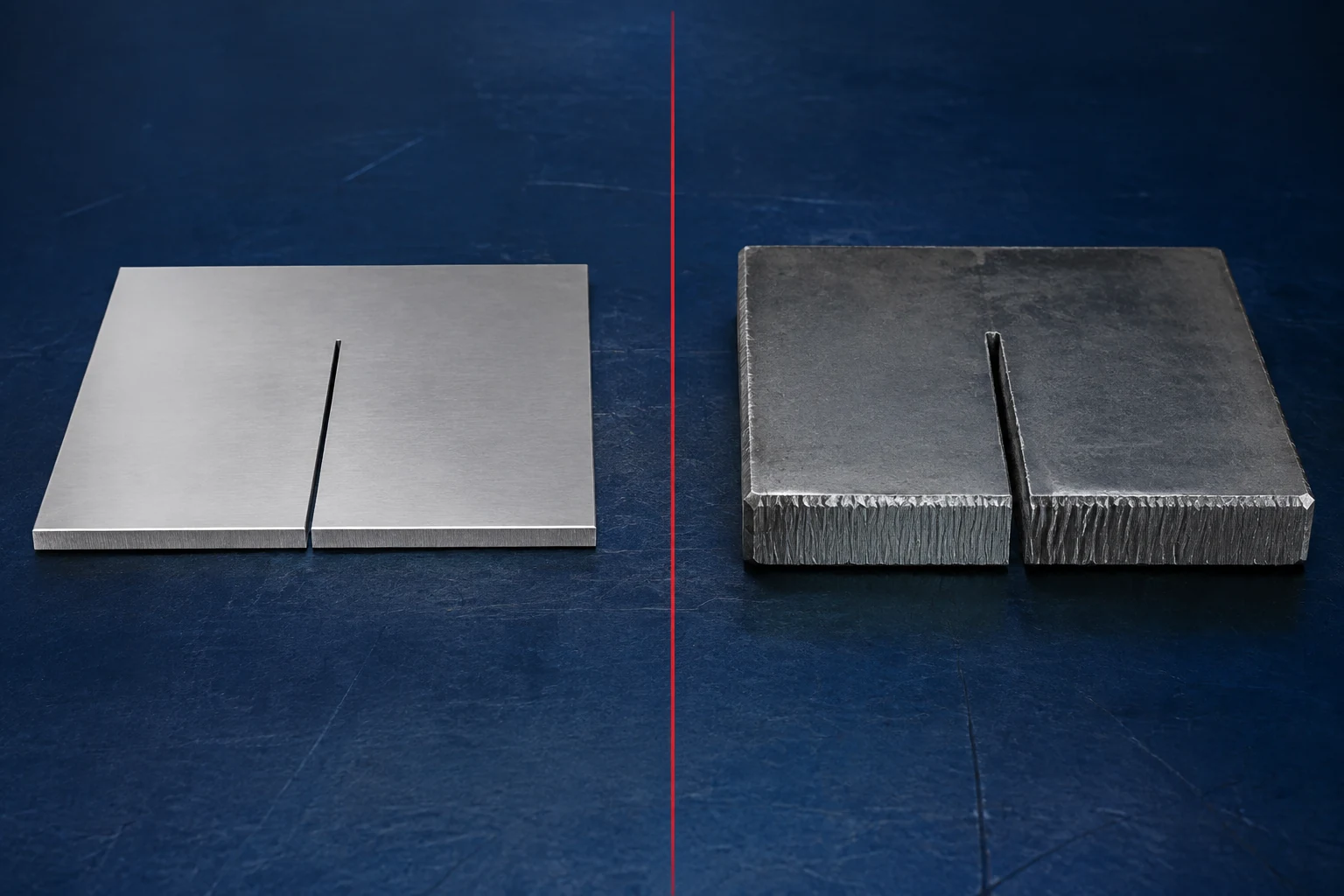
A plasma table can cost less to run for an hour and still cost more to deliver a box of finished brackets. The useful number for a repeat order is Canadian dollars per part that passes inspection. Run the same drawing on both machines and follow the parts through cleanup. A price per metre of straight cut can miss much of the work on a short run with many holes.
Set up a fair cutting trial
Choose two jobs from last month’s orders. A thin stainless panel with small holes exposes differences in pierce time and hole quality. A thicker mild-steel baseplate with long outside cuts puts more weight on sustained cutting and edge cleanup. Use the same grade, thickness, order quantity and drawing revision for both trials. Agree on hole tolerance, edge condition and the finish needed for the next operation before either machine starts.
What goes on the cost sheet?
| Input | Fiber laser | Plasma |
|---|---|---|
| Electricity | Meter kWh for the cutter, chiller and extraction over the run. | Meter the table, plasma power supply and extraction over the same scope. |
| Gas and air | Record assist-gas type and volume. Multiply by your delivered CAD price per unit. | Record the plasma and shield gases used. For shop air, allocate compressor and dryer cost once. |
| Wear items | Allocate nozzle and protective-window spend using your replacement history. | Allocate electrode, nozzle or cartridge spend using observed arc-on hours or pierces. |
| Labour | Time setup, loading, attended cutting, unloading, edge cleanup and inspection. Multiply actual labour hours by the shop’s loaded hourly rate. A second operator adds labour even when elapsed machine time stays the same. | |
Use the energy rate from your provincial utility bill and check whether a change in peak demand affects the monthly charge. Keep fixed monthly charges separate. If the gas supplier bills by cylinder, use the usable volume and your invoice price in matching units. Include rental or delivery once under the allocation method you choose.
A worked example in Canadian dollars
Suppose a shop trials the same 40-bracket nest. The figures below are invented to show the arithmetic. Both trials use one sheet. The example isolates conversion cost and excludes stock, financing, tax and fixed overhead.
| Batch input | Fiber laser | Plasma |
|---|---|---|
| Electricity at $0.15/kWh | 30 kWh × $0.15 = $4.50 | 24 kWh × $0.15 = $3.60 |
| Gas or allocated shop air | $18.00 | $5.00 |
| Allocated consumables | $3.00 | $7.00 |
| Labour at $40/hour | 0.75 h × $40 = $30.00 | 1.00 h × $40 = $40.00 |
| Batch conversion cost | $55.50 | $55.60 |
| Parts accepted | 40 | 38 |
| Cost per accepted part | $55.50 ÷ 40 = $1.39 | $55.60 ÷ 38 = $1.46 |
Here the difference is small enough to reverse. If plasma cleanup takes nine fewer minutes and yield stays at 38, the batch saves $6 in labour and costs $1.31 per accepted part. Check that cleanup time against the drawing’s edge requirement. If the customer needs all 40 parts, record the setup, stock and time for the two replacements before pricing the order.
Turn the trial into a buying decision
- Count the whole shift. Log both elapsed time and attended time. A machine can release the operator to other work while still occupying the cutting table.
- Price the material difference. For a delivered-part comparison, add sheet cost and deduct only scrap proceeds or remnant value the shop can actually recover.
- Weight the results by your orders. Multiply each job’s cost per accepted part by its monthly volume. Repeat with your last high gas invoice and your slowest observed cleanup time.
- Check ownership separately. Add annual service, lease or capital cost and site upgrades to the annual comparison. Keep those charges out of the batch figures if your hourly shop rate already recovers them.
For more detail, see Rise Tek’s fiber laser cost-per-finished-part guide and Hypertherm’s guide to comparing cutting processes.
Check these out
Compare the G3015 Mini S for compact sheet cutting and the HF Expert for a higher-power trial. Ask for the exact laser power, assist gas, nest time and inspection results alongside each machine quotation.