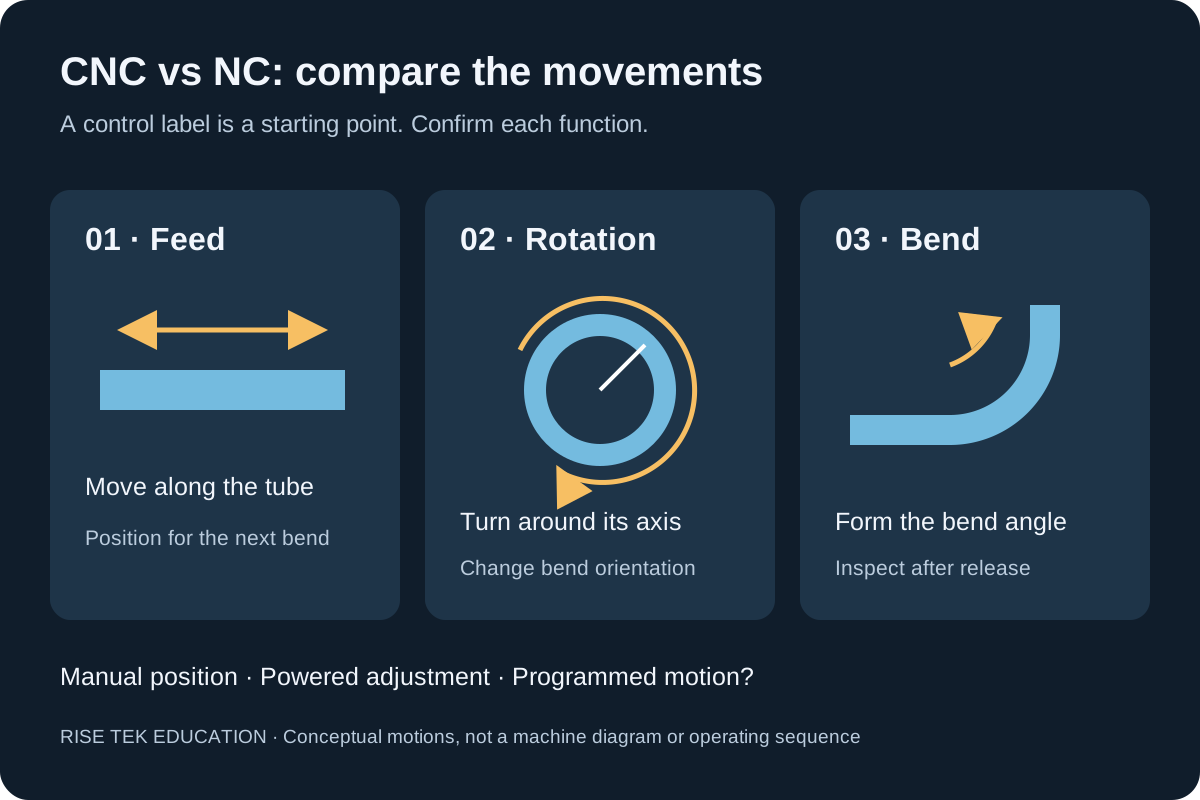
CNC tube benders generally offer programmed control over more of the part-forming sequence, while an NC configuration may leave more positioning to the operator. The useful comparison is which movements the quoted machine controls: feeding the tube, rotating it between bends and forming each bend angle. The label alone does not specify the complete package.
For Canadian fabricators, the choice should follow the part drawing, production mix and demonstrated cost per accepted part. A simple bracket and a multi-plane tube assembly can place very different demands on positioning, tooling and clearance. Neither CNC nor NC automatically establishes material capacity, finished tolerance or the need for a mandrel.
What do CNC and NC mean on a tube bender?
NC means numerical control; CNC means computer numerical control. In tube-bender catalogues, NC often describes a machine that stores or controls bend settings while an operator performs some other positioning tasks. CNC commonly describes a more extensively programmed sequence. Manufacturers use these labels differently, so compare a written function list and a demonstration.
Do not assume an NC machine has no program memory or no powered positioning. Equally, a CNC label does not mean automatic stock loading, finished-part unloading, collision avoidance or inspection is included. Ask what is standard, optional and manual on the exact configuration.
Compare feed, rotation and bending separately
| Movement | What it changes | Question for the supplier |
|---|---|---|
| Feed | Longitudinal tube position for the next bend | Is positioning manual, assisted or programmed? How is the position verified? |
| Rotation | Tube orientation around its length; the plane of subsequent bends | Is rotation manual, indexed or servo-controlled? Is it included in the saved sequence? |
| Bend | The forming angle around the bend tooling | Which angle settings and corrections can be stored, and how is the unloaded part checked? |
Axis letters and axis counts vary by machine. A five-axis description is not enough to identify all five functions, their drives or their interaction. Ask the supplier to name every controlled axis and show it on the proposed part. Keep the part’s required movements separate from catalogue speed figures.
CNC versus NC: compare the work, not just the screen
| Decision | NC configuration: check | CNC configuration: check |
|---|---|---|
| Single-plane or simple repeat parts | Operator positioning steps and a repeatable method for each | Whether programmed positioning reduces meaningful work on this part |
| Several bends in different planes | How feed and rotation are measured and repeated | Programmed sequence, part clearance and available tooling |
| Program recall | Which values are stored and which setup tasks remain | What recall restores and what must be checked again |
| Changeovers | Tooling changes, stops, settings and first-part checks | Programming, tooling changes, first-part checks and any simulation option |
| Finished-part quality | Sample results against the drawing | The same sample criteria; automation does not guarantee the result |
| Investment | Complete installed quote and operator time | Additional cost versus measured savings on accepted parts |
What the RollTek listings tell you
The following are specific examples from the current Rise Tek product listings, not guarantees for every model in a family. Confirm the delivered control, tooling and options in the quotation.
| Model | Listed control or configuration | Confirm before selection |
|---|---|---|
| ORBIT T38-C3 | 3-axis CNC | Exact axis assignments, drive functions and the proposed part sequence |
| ORBIT T38-C5 | 5-axis servo CNC; PC and 3D simulation listed | Which axes and software functions are supplied and validated on your drawing |
| MANDRA T38-N | NC / OMRON PLC / 7-inch touch; program storage listed | Which positioning movements remain manual; mandrel and wiper tooling are listed as optional |
| MANDRA T51-NR | NC / OMRON touch; manual feed and servo-controlled rotation listed | How feed is positioned and rotation is commanded within the complete cycle |
The MANDRA T51-NR example shows why “NC equals entirely manual positioning” is too broad. The ORBIT examples show why a higher axis count still needs a function-by-function review. Do not infer a CNC-only capability from another manufacturer’s catalogue or extend one model’s features to the whole RollTek range.
Mandrel bending is a separate decision
A mandrel supports the tube internally during bending. Its suitability depends on the tube dimensions, material, bend geometry and required finished quality. It is not a synonym for CNC. An NC machine can use mandrel tooling, and a CNC machine still needs an application-specific tooling review.
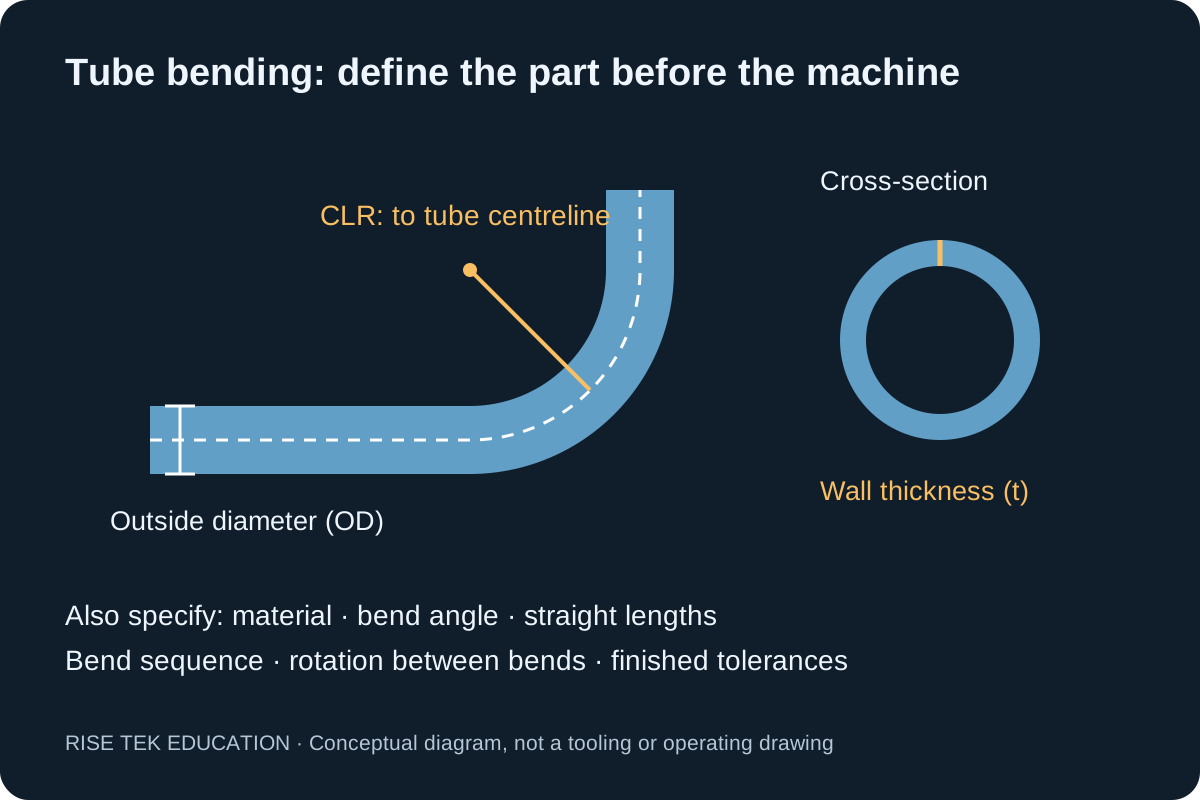
Supply OD or section dimensions, actual wall thickness, material grade, centreline radius, bend angles, straight lengths and the full 3D geometry. Include surface and dimensional requirements. Our tube-bender quotation checklist helps prepare that information without confusing control features with capacity.
Two shop scenarios to test
Repeated single-plane parts: if the proposed NC configuration can make the required geometry and operator positioning fits the workload, it deserves a trial. Compare setup, handling and repeatability before paying for functions that may not remove the bottleneck. Low volume alone is not a reason to rule out CNC when the geometry demands more control.
Recurring multi-plane parts: programmed feed and rotation may reduce repeated positioning work where those functions are included. Demonstrate the whole part, including clearance, clamping, removal and the first part after a changeover. A complicated shape can justify further automation review even when batch sizes are modest.
Measure complete cycles and accepted parts
Use the same drawing, material and acceptance criteria for both demonstrations. Record setup and first-part approval separately, then time loading, positioning, bending, unloading and inspection for consecutive parts. Record rejected parts and rework. A machine’s bend speed is only one component of the result.
For a simple labour comparison, divide total recorded operator time by accepted quantity. Keep equipment cost, tooling, maintenance and consumables separate so the assumptions remain visible. There is no reliable universal batch threshold, percentage productivity gain or payback period that applies to every NC-versus-CNC purchase.
Canadian quotations should state currency and include tooling, software, freight, rigging, commissioning, training and service scope. Confirm utilities and documentation for the delivered configuration. Download the blank CNC-versus-NC comparison worksheet and ask Rise Tek to review the most demanding part alongside a representative repeat job.
Before a demonstration, use the tube-bend sample-acceptance guide to agree measurements, consecutive samples and a repeat-setup review.
Check these out
Send your drawing for a model-specific application review.
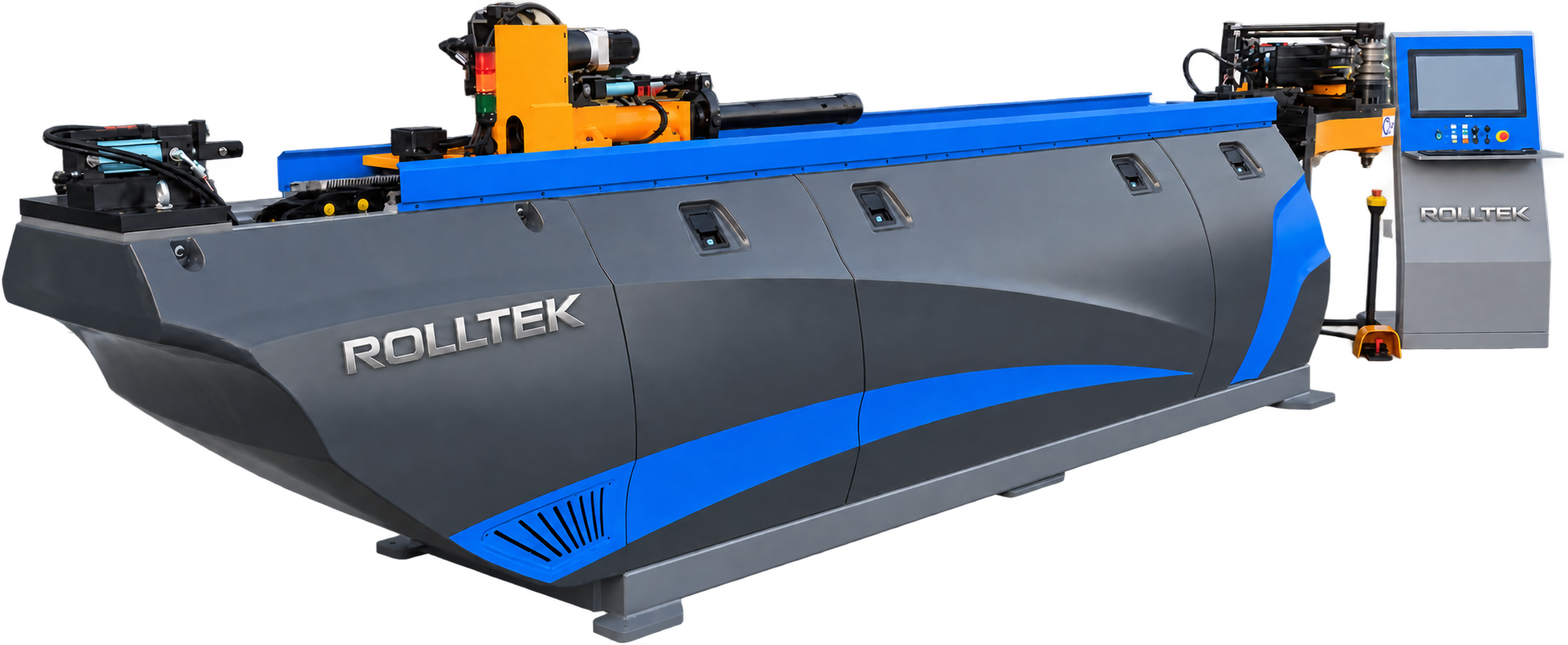
RollTek ORBIT CNC tube benders
Explore the CNC range and confirm each programmed axis, tooling set and software option. Existing branding visualization; final appearance follows the quotation.
Explore machines →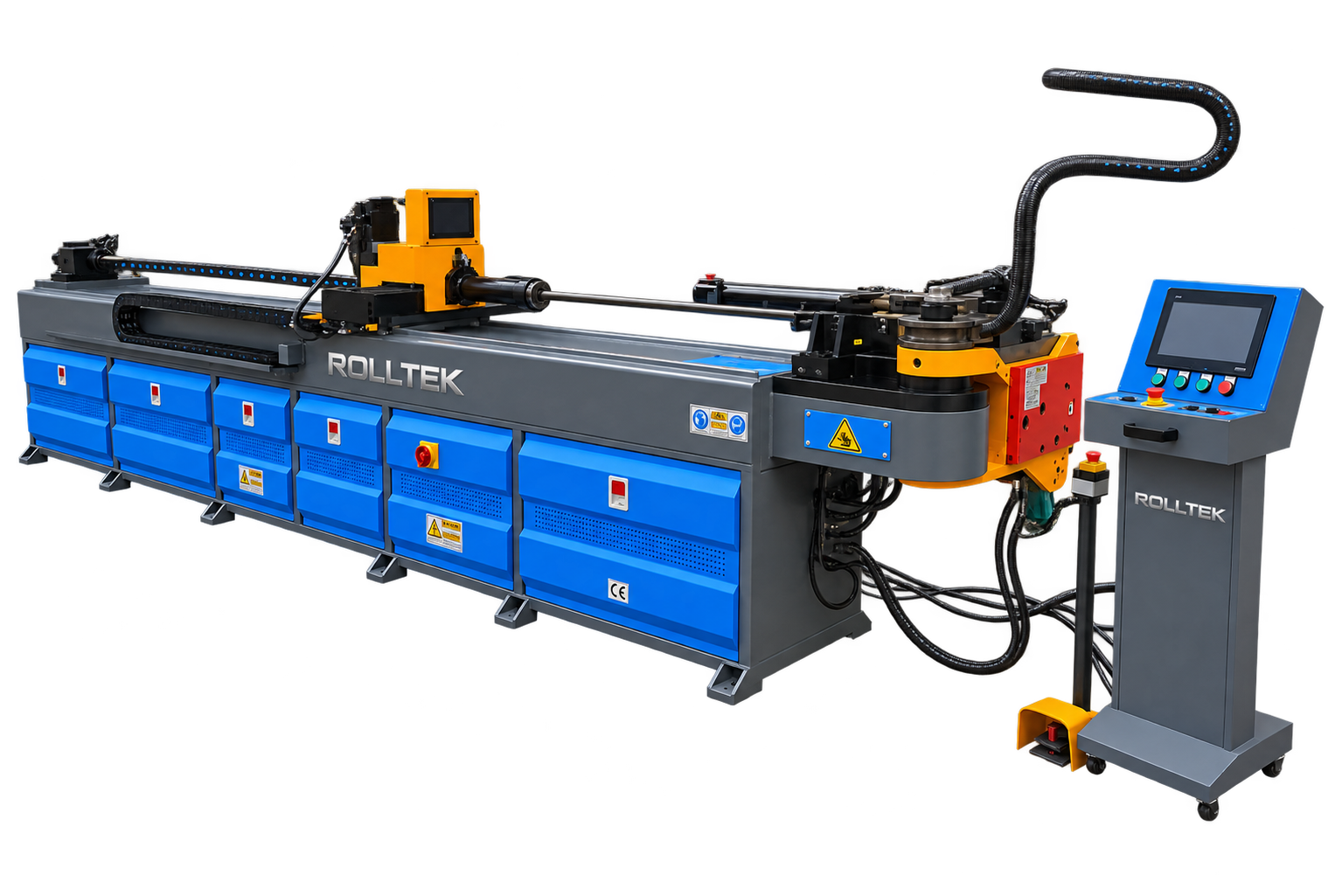
RollTek MANDRA T51-NR
Review this NC example with listed manual feed and servo-controlled rotation. Confirm the full cycle for your part. Existing branding visualization.
Explore machines →Frequently asked questions
What is the main difference between CNC and NC tube benders?
CNC configurations commonly program more of the sequence, while an NC configuration may leave more positioning to the operator. Compare feed, rotation and bend control on the exact model rather than relying on the label.
Can an NC tube bender have servo-controlled rotation?
Yes. The RollTek MANDRA T51-NR listing specifies manual feed and servo-controlled rotation. Confirm the exact supplied configuration and how each movement is commanded.
Does a CNC tube bender always include a mandrel?
No. CNC describes control functions; a mandrel is internal tube support. Confirm tooling separately for the material, wall thickness, radius and finished-part requirements.
Does more CNC control guarantee faster production?
No. Measure setup, loading, positioning, bending, unloading and inspection on representative parts. Compare accepted output and rework rather than bend speed alone.
What should I send to compare CNC and NC quotations?
Send the drawing or 3D model, material specification, tube dimensions, centreline radii, bend sequence, tolerances and production quantities. Ask for a written movement-by-movement control and tooling comparison.