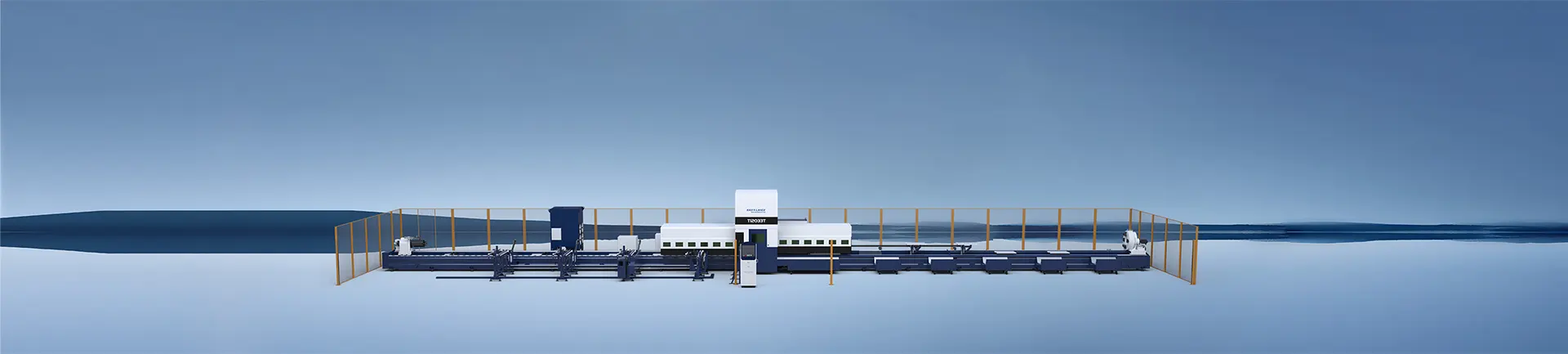
A flatbed fiber laser cuts sheet. A fiber laser tube cutting machine cuts everything else — round tube, square tube, structural H-beam, angle iron, C-channel — fast, precisely, and without the manual layout and fixturing that slows down saw-and-drill methods.
This guide covers how a tube laser works mechanically, what profiles it handles, how to choose the right power for your wall thicknesses, and how to decide between a dedicated tube laser and a flatbed attachment. We'll also compare Han's Laser's two tube cutting series — TX and PD — with actual specifications so you can match the right machine to your production profile.
How a Fiber Laser Tube Cutting Machine Works
A flatbed laser moves a sheet on a stationary table while the cutting head traverses X and Y. A tube laser flips that logic: the tube is held in a rotating chuck system and fed along the machine's Z axis (the tube length axis), while the cutting head moves in X and Y.
This creates a 4-axis machine: X (head left-right), Y (head up-down), Z (tube feed direction), and A (chuck rotation). The CNC interpolates all four axes simultaneously, which is what allows the machine to cut holes, slots, and notches at any angle anywhere on the tube — including beveled cuts for weld preparation — without touching the tube or repositioning a fixture.
A typical structural tube part requires sawing to length, drilling mounting holes, and notching or coping for welded joints. On a CNC tube laser, all three operations happen in a single uninterrupted program. No layout, no fixture changes, no secondary operations. A job that takes 20 minutes at a saw-and-drill station takes 2–3 minutes on a tube laser — and the part comes out ready to weld.
Tube Profiles a Fiber Laser Can Cut
The profile range depends on the chuck jaw set and machine model, but a modern tube laser handles far more than round and square tube.
The key constraint is the chuck's maximum inscribed circle — the largest round tube that fits inside the chuck jaws at full open. Everything else (square, rectangular, oval) must fit within that circumscribed envelope. The TX Series handles up to Ø660mm; the PD Series up to Ø180mm.
Chuck Systems: 2-Chuck, Tri-Chuck, and Four-Chuck Explained
The number of chucks is one of the most important specifications on a tube laser — more so than power for most shops — because it determines what tube lengths, diameters, and weights you can process accurately.
For large-diameter or heavy tube — structural H-beams, Ø400+ round sections, tubes approaching 12m in length — a 2-chuck machine simply cannot maintain the required accuracy. The tube sags and vibrates between the chucks, producing a cut that wanders in the Z axis. Tri- and four-chuck machines solve this with servo-driven floating supports that ride under the tube and adjust dynamically as the tube feeds through.
Power Selection: Matching Laser Power to Wall Thickness
Tube wall thickness drives power selection more directly than tube diameter. A 500mm round tube with a 3mm wall is easier to cut than a 50mm square tube with an 8mm wall — because you're cutting the same 3mm of steel in the first case and 8mm in the second.
| Wall Thickness | Recommended Power | Typical Speed (Mild Steel) | Notes |
|---|---|---|---|
| ≤ 2mm | 1 kW | 8–15 m/min | Light tube, furniture, HVAC fittings |
| 2–4mm | 1.5–2 kW | 4–8 m/min | General fabrication, square tube HSS |
| 4–6mm | 3–4 kW | 3–5 m/min | Medium structural, automotive chassis |
| 6–10mm | 4–6 kW | 1.5–3 m/min | Heavy structural, CHS pipe, piling |
| 10–20mm | 6–12 kW | 0.8–2 m/min | Heavy pipe, shipbuilding, structural sections |
| 20mm+ | 12 kW+ | 0.3–1 m/min | Thick-wall pipe, heavy H-beam flanges |
The PD Series is available from 1–4kW, which covers the 2mm–6mm wall range that accounts for the majority of furniture, automotive, HVAC, and light structural fabrication. The TX Series is offered with higher power options for heavy-wall structural tube and pipe.
When choosing laser power for tube cutting, always calculate based on your maximum wall thickness — not your average wall thickness. The machine needs to handle your hardest job reliably, not just your typical one.
What Is Zero-Scrap Tube Cutting?
On a conventional tube laser, a fixed remnant length remains at the end of each bar — typically 100–200mm — because the chuck cannot release the tube end during cutting. That leftover piece is unusable scrap.
Zero-scrap cutting eliminates this waste. In the Han's Laser TX Series, the cutting head mechanism is designed to cross over the center chuck position. The machine can continue cutting right to the physical end of the tube, leaving zero unusable remnant.
Zero scrap is economically significant at scale:
- On a 6m bar of stainless steel tube, a 150mm remnant represents 2.5% material waste per bar
- At 50 bars per shift, that's 7.5m of stainless tube scrapped daily
- At stainless prices of $8–12/kg, zero scrap pays back measurably in heavy-volume operations
For carbon steel at lower volumes, the financial impact is smaller — but zero scrap is still a cleaner operation with less remnant inventory to manage.
Han's Laser TX Series vs PD Series
Rise Tek supplies two Han's Laser tube cutting platforms, each built for a different production profile.
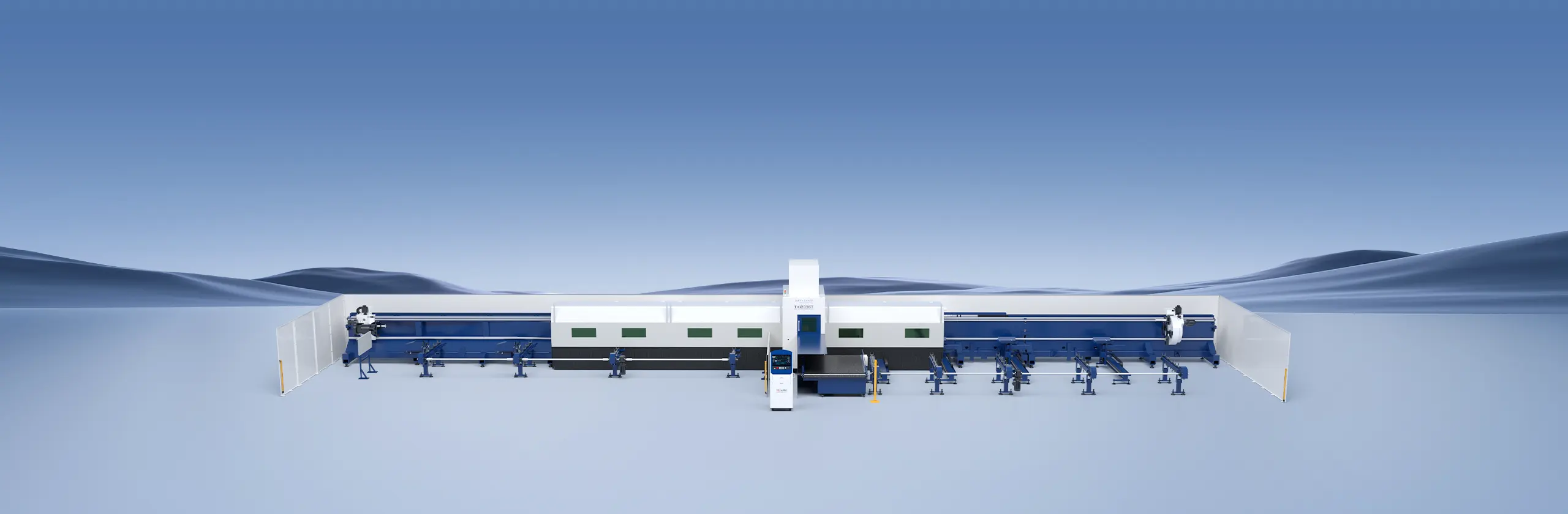
- Tri-chuck and four-chuck configurations
- True zero-scrap cutting
- Optional ±45° bevel cutting
- Side-mounted bed for rigidity
- Follower-assisted floating support
- Semi-automatic loading
- H-beam, I-beam, structural angle
- Pneumatic 4-claw self-centering chuck
- Fully enclosed dustproof chuck system
- Digital clamping monitoring
- Servo floating support
- Semi-auto and fully-auto feeding options
- Internal oil circulation for 24h operation
- 4 models: P6010D to P10018D
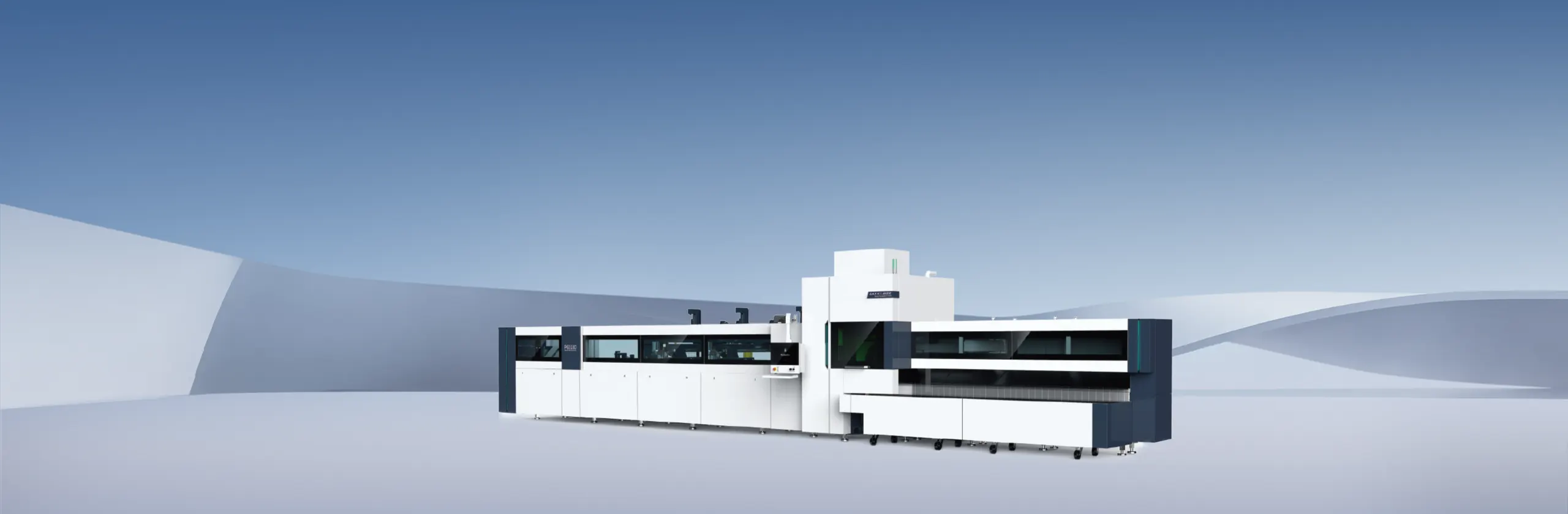
TX Series Models at a Glance
| Specification | TX12036T | TX12050T | PX12066F |
|---|---|---|---|
| Round Tube Range | Ø40–360mm | Ø50–500mm | Ø80–660mm |
| Square Tube Range | □40–350mm | □50–500mm | □80–450mm |
| Chuck Config | Tri-Chuck | Tri-Chuck | Four-Chuck |
| Max Tube Weight | 1,200 kg | 2,000 kg | 2,500 kg |
| Positioning Accuracy | ±0.05mm/1000mm | ±0.05mm/1000mm | ±0.01mm/1000mm |
| Max Speed | 60 m/min | 60 m/min | 40 m/min |
| Zero Scrap | ✓ | ✓ | ✓ |
Dedicated Tube Laser vs Flatbed with Rotary Attachment
Many flatbed fiber lasers can be fitted with a rotary attachment — a powered V-roller that rotates tube under the cutting head. This is a reasonable solution for occasional tube work, but it has hard limits that matter for production environments:
| Factor | Dedicated Tube Laser | Flatbed + Rotary |
|---|---|---|
| Max Tube Length | Up to 12m | Typically 1.5–3m |
| Max Tube Diameter | Up to Ø660mm | Usually ≤Ø150mm |
| Heavy Tube Support | ✓ Floating servo supports | ✗ V-rollers only |
| Through-Feed Capability | ✓ Continuous | ✗ Fixed length per setup |
| Throughput vs Saw | 3–5× faster | 1.5–2× faster |
| Flatbed Productivity | Separate machine needed | ✓ Same machine, swap setup |
| Right for | Regular tube production | Occasional tube work |
The decision is straightforward: if tube cutting represents more than 20–30% of your production volume, a dedicated tube laser pays back faster through throughput and setup time savings. If tube is incidental to your sheet work, a rotary attachment avoids the capital cost of a second machine.
Industries That Use Fiber Laser Tube Cutting
The applications span nearly every metal fabrication sector:
- Structural steel fabrication — connection holes in columns, coped beam ends, purlin notches, anchor bolt patterns. Jobs that previously required a full layout-and-drill cycle
- Automotive — chassis rails, roll cages, exhaust manifolds, sub-frame components. Tight tolerances in high volumes
- Furniture and fitness equipment — tubular steel frames, handrails, gym equipment. The PD Series at 120 m/min handles high-volume small-tube production
- HVAC and mechanical — ductwork fittings, pipe stubs, mechanical equipment frames
- Agricultural equipment — greenhouse structures, irrigation pipe manifolds, equipment frames
- Shipbuilding — large-diameter pipe runs, structural hull sections where the TX Series handles the tube sizes involved
- New energy — solar panel mounting structures, wind turbine component frames
What to Evaluate Before Buying a Tube Laser
Five questions that determine which machine is right for your shop:
- What is your maximum tube diameter? If you regularly cut Ø180mm or smaller, the PD Series covers everything. If you need Ø200mm or larger — or structural H-beam — you need the TX Series.
- What is your maximum wall thickness? This determines laser power. Most light and medium fabrication falls in the 1–4kW PD Series range. Heavy structural wall thickness pushes you toward higher-power TX Series configurations.
- What tube lengths do you typically process? Both series handle up to 12m standard length stock. If you're cutting shorter stock (under 6m) predominantly, a smaller footprint may be preferable.
- Do you need bevel cutting? Bevel cuts for weld prep are only available on the TX Series with the optional ±45° bevel cutting head. The PD Series does straight cuts only.
- What is your automation requirement? Both series support semi-automatic feeding. The PD Series also offers fully-automatic bundle loading for lights-out tube production.
Han's Laser tube cutting machines are available with different laser source power levels within each series. When spec'ing a machine, confirm that the power option you're quoting on is available with the tube size and chuck configuration you need — not all power levels are offered on all models.
Summary: Which Series Is Right for You?
Choose the PD Series if your tube work is predominantly Ø20–180mm round and square tube at moderate-to-high volumes, with wall thickness up to 6mm and no need for bevel cutting. Furniture, fitness, automotive components, HVAC, and light structural fabrication all land here.
Choose the TX Series if you cut large-diameter tube (over Ø180mm), heavy-wall structural sections, H-beam or open profiles, or if you need bevel cutting for weld prep. Structural steel contractors, heavy equipment fabricators, shipyards, and pipe fabrication shops are the natural fit.
If you're regularly cutting both small-tube production parts and occasional large structural work, a two-machine solution — PD for volume, TX for heavy structural — is the highest-throughput answer for a larger operation.