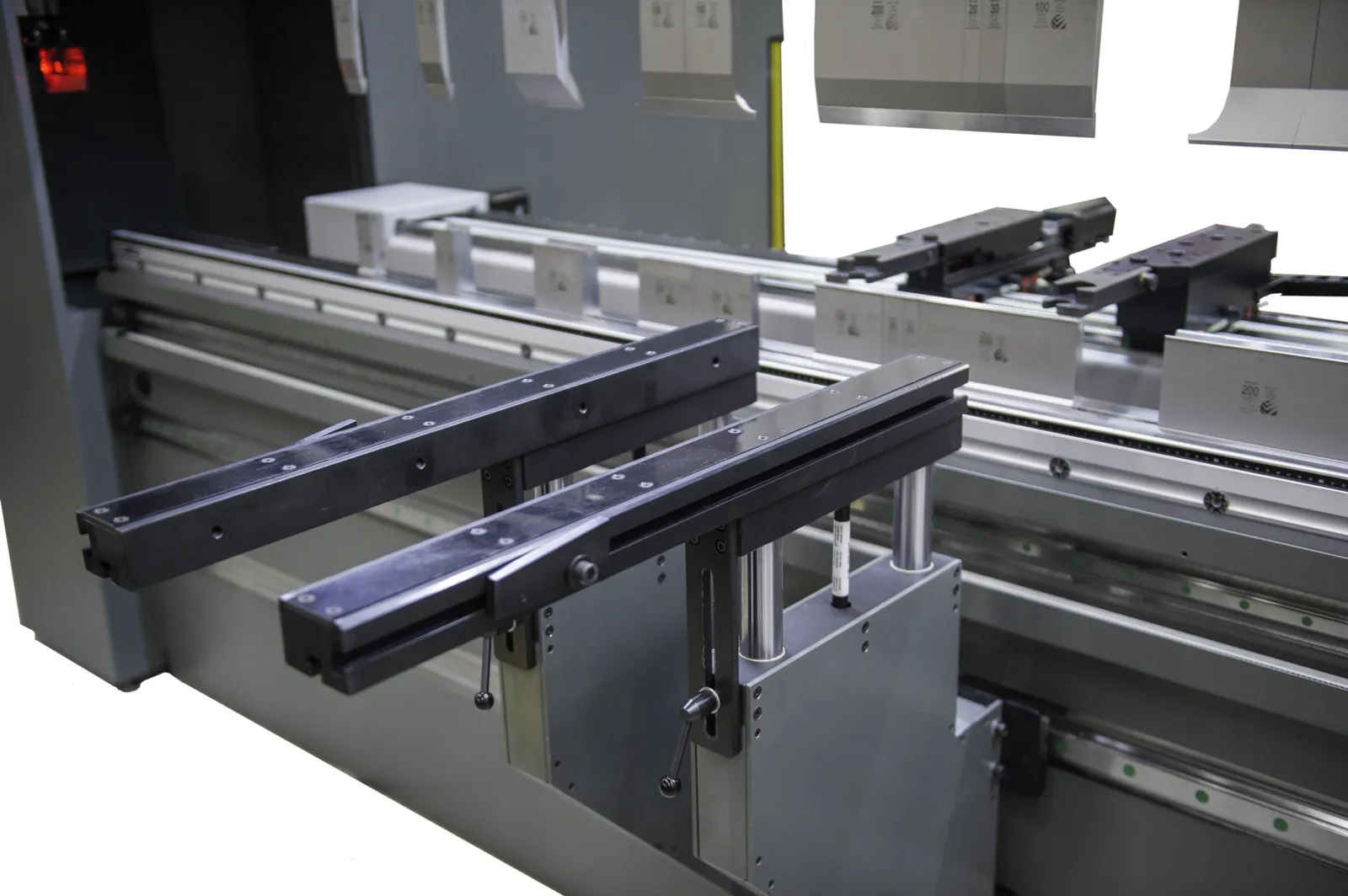
Buying a CNC press brake is a 10–15 year decision. Get the tonnage wrong and you are fighting the machine on every thick part. Get the bending length wrong and you are splitting jobs across two setups that should be one. Get the back-gauge axis count wrong and your operator spends 40 minutes positioning manually for every tool change.
This guide walks through the three technical decisions that matter most, explains the Haco vs Dener choice for Canadian shops, and gives you a structured evaluation framework.
Step 1: Calculate the Tonnage You Actually Need
The most common sizing mistake is buying too little tonnage because the shop only prices the thickest part they currently cut — and not the longest part. Bending force scales with part length, not just thickness. A 3 m bend in 6 mm mild steel needs more tonnage than a 500 mm bend in the same material.
Tonnage = (Material factor × Thickness² × Bending length) / Die opening
For mild steel (factor = 8): a 3,000 mm × 6 mm bend with a 48 mm die opening = 8 × 36 × 3 / 48 = 18 tonnes per metre × 3 m = 54T. Always add 30–50% safety margin and cross-check with the bending chart your tooling supplier provides.
Tonnage Quick Reference
| Tonnage | Typical material range | Best for |
|---|---|---|
| 60–100T | Up to 4 mm mild steel, short parts | Light fab, HVAC, enclosures |
| 135–165T | Up to 6 mm mild steel, up to 3 m | General fabrication |
| 175–220T | Up to 8 mm, 3–4 m | Most common production sweet spot |
| 250–320T | Up to 12 mm, 4 m+ | Structural steel, heavy plate |
| 400T+ | 16 mm+ plate | Heavy industrial, beam fabrication |

Step 2: Match Bending Length to Your Longest Part
The standard bending length for a mid-range press brake is 3,100 mm (about 10 ft). This covers the vast majority of sheet metal and light structural work. If your shop regularly handles parts wider than 2.4 m, step up to 4,000 mm.
One factor often missed: back crowning. On bending lengths above 2 m, beam deflection under load causes the centre of the bend to sag relative to the ends — producing an angle that is tighter at the edges than the centre. CNC-controlled hydraulic crowning corrects this automatically. If you're quoting parts with tight angular tolerances across a full-length bend, confirm the machine has active crowning.
Step 3: Choose Your Back-Gauge Axis Count
The back gauge positions material before each bend. More axes mean the gauge can move, rotate, and tilt — eliminating manual repositioning between bends on complex parts.
Haco vs Dener: Which Is Right for Your Shop?
Rise Tek carries both Haco and Dener press brakes because they are genuinely different machines for different buyer profiles — not the same machine with different branding.
Haco (North American)
- Belgian engineering, North American sales and support infrastructure
- Strong Canadian dealer network, local service contracts available
- CYBELEC or DELEM controls — widely familiar to North American operators
- Best for: shops where operator familiarity, parts availability, and NA-standard service are top priorities
- Typical lead time: 12–16 weeks
Dener (Turkish)
- Turkish-built with European component sourcing (Bosch Rexroth hydraulics, Delem/CYBELEC controls)
- Competitive capital cost at equivalent tonnage and length
- ISO-certified manufacturing; Rise Tek provides Canadian service coverage
- Best for: shops making a capacity decision where capital cost is a primary constraint
- Typical lead time: 12–16 weeks
If your shop already runs Delem or CYBELEC controls on existing equipment, either brand transitions smoothly. If operator familiarity and minimal retraining are priorities, Haco's North American footprint makes the service relationship easier. If your primary constraint is maximizing tonnage-per-dollar invested, Dener is worth shortlisting.
Evaluation Checklist (7 Questions Before You Buy)
You need both to calculate tonnage correctly. Do not size to thickness alone.
Critical for tight angular tolerance across parts longer than 1.5 m. Verify it adjusts automatically from the control, not manually with shims.
European-style Wila and Trumpf tooling is widely available in Canada. Confirm compatibility if you have existing tooling inventory.
±0.01 mm ram repeatability is the production standard. Anything above ±0.02 mm will show up in angular variance on tight-tolerance parts.
Integrated laser or optical angle measurement allows the machine to close the loop on springback automatically — eliminating trial bends on new programs.
Ask for the specific name of the service technician who would cover your location, not a general "national coverage" answer.
A hydraulic seal kit or proportional valve should be available same-day or next-day. Confirm parts inventory is held in Canada, not imported per-order.
The Haco hydraulic press brake lineup covers 60T through 320T with active crowning standard above 135T. For shops where capital cost drives the decision, the Dener servo-electric series delivers competitive tonnage at a lower energy cost per cycle. Our team will help you model both options against your actual part mix.
Frequently Asked Questions
How much tonnage do I need to bend 6 mm mild steel at 3 metres?
Using the standard air bend formula with a 48 mm V-die, approximately 54 tonnes is the calculated requirement. Applying a 40% safety margin puts the practical recommendation at 80T minimum for that bend — and 135T or above if you want headroom for longer or thicker parts in the same shift.
What is the difference between hydraulic and servo-electric press brakes?
Hydraulic machines use a pressurized oil circuit to drive the ram — proven, widely serviceable, and well-suited to high-tonnage applications. Servo-electric machines use ball screws driven by electric servos — more energy-efficient per stroke, faster at light tonnage, and produce no hydraulic fluid contamination risk. For most Canadian shops under 250T, both technologies perform well; the decision typically comes down to operating cost preference and part mix.
Is 6-axis back gauge worth the cost for a general fabrication shop?
If your shop regularly programs parts with more than three bends, multiple flange heights, or angled flanges, yes — the time saved on setup programming pays back the axis cost within the first year of production. For a shop running simple enclosures and brackets with 1–2 bend sequences, a 4-axis gauge is typically sufficient.