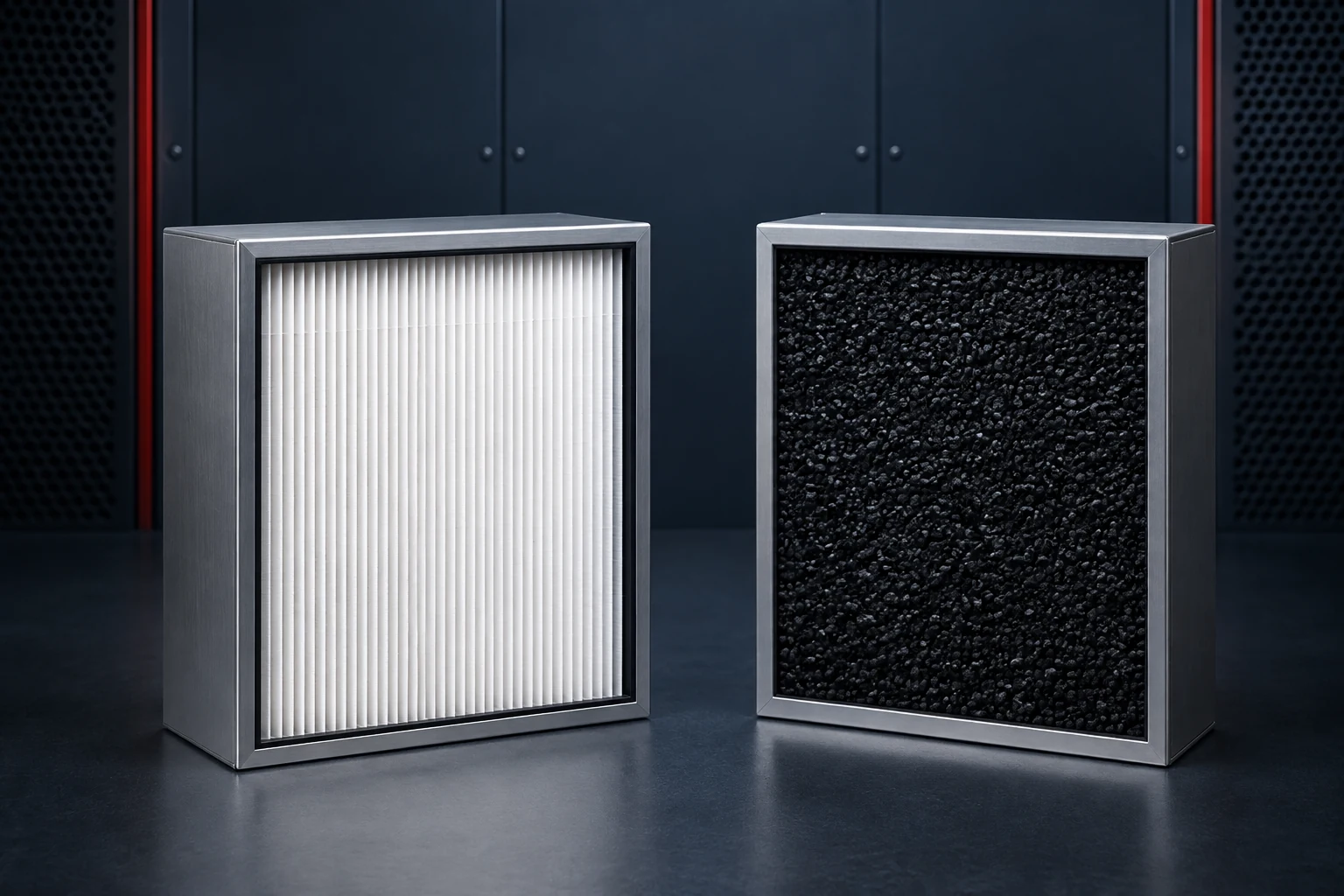
HEPA versus carbon is the wrong comparison
These two are not competing options. They capture different things, and a shop that treats them as alternatives usually ends up either paying for filtration it does not need or leaving a genuine exposure uncontrolled.
A particulate filter — HEPA, or ULPA above it — traps solid particles. That is what metal fume is: fine solid metal oxide, condensed out of vapour the moment it leaves the cut. Activated carbon does something entirely different. It adsorbs gases and vapours onto a very large internal surface area. It has essentially no effect on particulate, and a particulate filter has essentially no effect on solvent vapour coming off painted stock.
Most laser extraction units are built as a stack rather than a single filter: a coarse pre-filter to catch the large material and protect what sits behind it, a particulate stage doing the real work, and — where the material calls for it — a carbon stage for gases.
Two definitions worth having straight, because both turn up on quotes. Under the North American convention, HEPA means 99.97% efficient at 0.3 microns, and ULPA is tighter at 99.999% at 0.12 microns. European units are usually graded to EN 1822 instead, where you will see H13 and H14 classes rated at the most penetrating particle size. These are not interchangeable labels, so compare the stated efficiency rather than the acronym.
What fiber laser cutting actually puts in the air
The fume from a fiber laser is dominated by ultrafine particulate, a large share of it well below one micron. This is the part that catches shops out, because particles at that size are individually invisible. A cutting cell can look and smell clean while producing exactly the fraction that stays airborne longest and travels deepest into the lung.
A clean-looking machine is not evidence of anything. Visible dust is the coarse fraction, which settles out and which your eyes will notice anyway. The fraction that matters most for long-term health is the one you cannot see.
HEPA is rated at 0.3 microns because that is the hardest particle size to capture, not because it is the smallest the filter handles. Below that size particles move erratically and are captured by diffusion, so efficiency climbs again. A HEPA stage is not letting your ultrafine fume straight through.
The material decides the hazard
What you cut matters more than what you cut it with. The extraction question is really a materials question.
Mild steel
Iron oxide particulate. A particulate stage handles it. This is the straightforward case, and the one most shops are correctly set up for.
Stainless steel
This is the one to take seriously. Cutting stainless can generate hexavalent chromium, classified by the International Agency for Research on Cancer as a Group 1 carcinogen — the category for agents with sufficient evidence of carcinogenicity in humans. Nickel is in the mix as well. Nothing about the cut looks or sounds different, which is precisely the problem: the risk is invisible and cumulative, and it is easy to run stainless on an extraction setup that was specified back when the shop only cut mild steel.
Galvanized steel
Zinc oxide, and the reason metal fume fever exists. It presents as flu-like symptoms some hours after exposure and usually resolves on its own, which is exactly why it gets shrugged off. It should not be. It is a straightforward signal that somebody was breathing fume they should not have been.
Aluminium
Aluminium oxide particulate. Worth remembering that aluminium fines are combustible, so how the collected dust is stored and handled matters, not only whether it was captured.
Painted, coated and oily stock
This is where carbon finally earns its keep. Heat breaks the coating down and releases volatile organic compounds — actual gases, which no particulate filter will touch. If you regularly cut painted, powder-coated, primed or oily material and your stack is particulate-only, the gas fraction is going straight through it.
Why nobody can give you an airflow figure from wattage
This is the most common question and it has the least satisfying answer. Extraction airflow is not a function of laser power. A well-sealed 6kW machine ducted sensibly can need less air than a 3kW machine sitting at the end of a long, badly routed run.
What actually sets the requirement:
- The enclosure volume, and how the machine is ported for extraction
- The capture velocity needed at the source to draw fume in before it escapes the enclosure
- Duct diameter, total run length and the number of bends — every one of which costs static pressure
- The pressure drop across the filter stack, which is not a fixed figure and rises as the filters load
- Whether the system recirculates or exhausts outdoors
The sequence that works: start from the machine builder's stated extraction requirement for your specific machine, then have the system sized to actually deliver that at your duct configuration — not on paper, and not at the fan's free-air rating. If a supplier quotes you an airflow number off laser wattage alone, they have not asked enough questions to know the answer.
Recirculate, or exhaust outside?
Exhausting outdoors is the more conservative choice. Whatever gets past the filter leaves the building, so filter breakthrough is not an exposure event on your shop floor. The cost is heat: you are replacing conditioned air with outside air, and through a Canadian winter that is a real and recurring number.
Recirculating keeps the heat and shifts the burden entirely onto the filtration. The filter becomes the only thing between the fume and the people working around the machine. That is a defensible choice, but it raises the standard — housing integrity, differential pressure monitoring and change discipline all stop being optional.
Plenty of shops split it: recirculate while running bare mild steel, exhaust when stainless or coated material is on the bed. If you do recirculate through stainless work, be clear-eyed that you are relying on a filter to control a carcinogen.
Filters load, and airflow falls before anyone notices
Extraction performance is not static. As a filter fills, the pressure drop across it rises and the airflow through the system falls. It happens slowly and without any obvious signal — the machine sounds the same and the cut looks the same. A system commissioned correctly can be well below its design airflow a year later with nobody aware that anything changed.
Which is why the answer to "when do I change filters" is differential pressure, not a calendar date and certainly not visual inspection. Monitor the pressure differential across the filter and change against the manufacturer's threshold.
Two habits that pay for themselves. Keep pre-filters on their own schedule, because they are inexpensive and their entire job is protecting the costly particulate stage. And treat spent filters from stainless work as contaminated waste rather than shop rubbish, because everything the filter captured is still sitting in it.
Where the Canadian rules actually sit
Occupational health and safety in Canada is regulated provincially. There is no single national fume limit to point at, and the specific obligations depend on where you operate — Ontario, Alberta, British Columbia and Quebec each publish their own.
The consistent principle across jurisdictions is the employer's duty to keep worker exposure below the occupational exposure limit that applies there for the substances involved. Those limits differ between provinces and are revised periodically, which is exactly why we are not going to print a table of numbers here that could be wrong for your province, or out of date, by the time you read it. Check your provincial regulator.
If stainless is a regular part of your mix, this is worth more than a filter purchase. An occupational hygienist can tell you what your operators are actually exposed to, which is a different question from what your equipment is rated for.
Particulate filtration for the metal fume. Carbon only if you cut coated or oily stock. Sizing from the machine builder's specification rather than from wattage. Differential pressure to decide filter changes. Extra care on stainless. Everything else is detail.