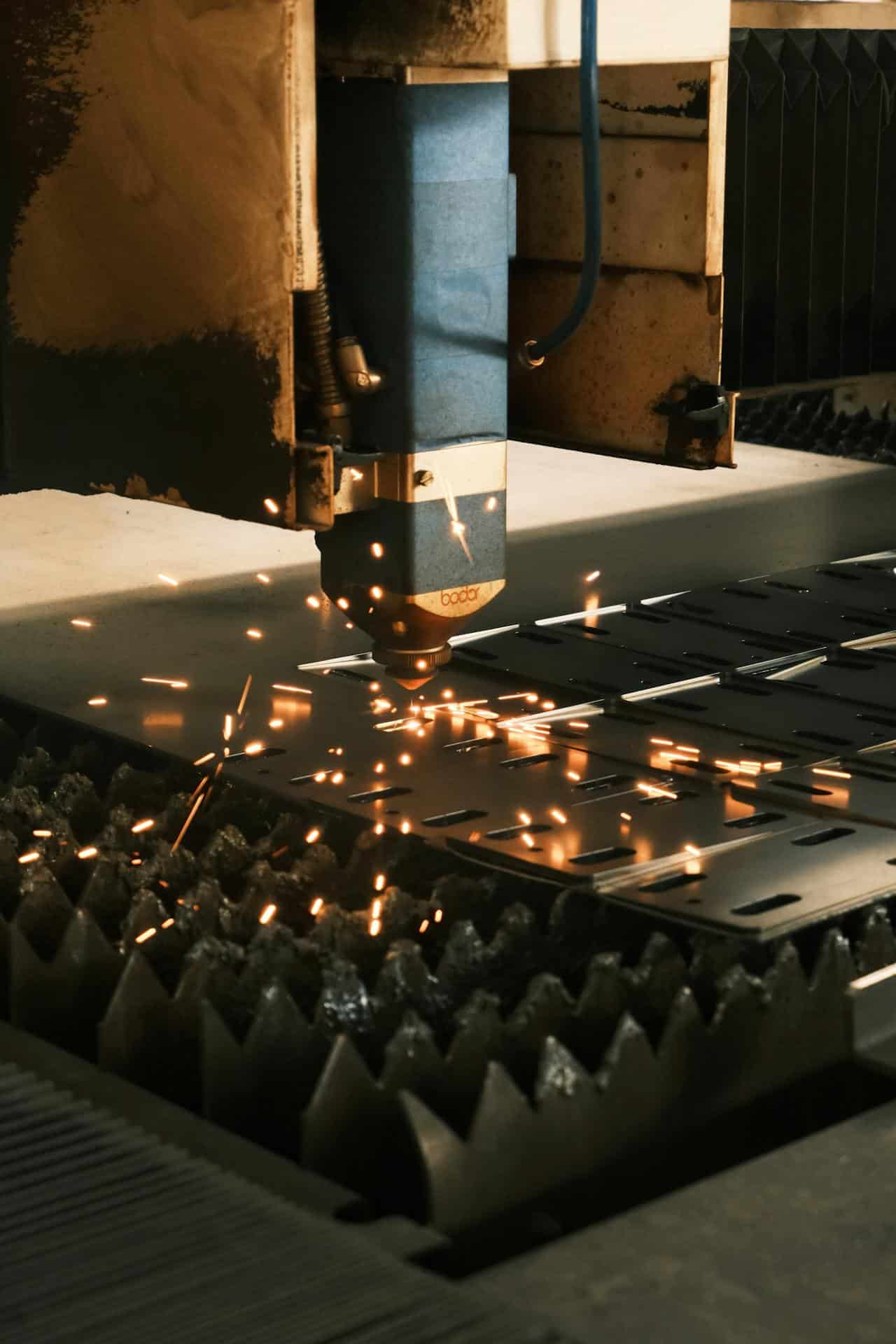
Most fiber laser cut-quality problems that don't trace back to a parameter setting come down to one of four small parts on the cutting head. None of them are expensive, and all of them are meant to wear out — the trick is catching them before a worn part starts producing bad parts instead of just failing outright.
Protective Lens (Protective Window)
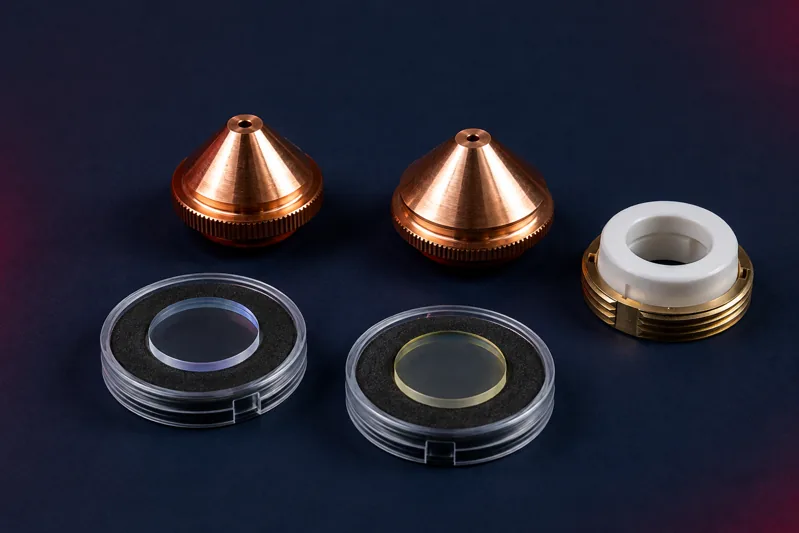
The protective lens is a sacrificial piece of glass that sits between the focusing optics and the cutting zone, taking the brunt of spatter and debris so the expensive optics behind it don't have to.
Inspect for: visible spatter specks, a hazy or cloudy appearance instead of clear glass, pitting, or any crack.
Replacement guidance: inspect daily and replace every 1–4 weeks depending on material type and hours. Cutting galvanized, coated, or reflective metals degrades the lens faster than clean mild steel or stainless. Keep 5–10 spares in stock so a worn lens never turns into unplanned downtime.
A contaminated protective lens is one of the most common causes of rough cut edges — it distorts and weakens the beam before it ever reaches the material, so if edge quality drops without any parameter changes, this is the first thing to check.
Cutting Nozzle
The nozzle shapes and directs the assist gas flow that clears molten material from the kerf as the beam cuts. A damaged nozzle doesn't stop the machine from cutting — it just quietly degrades the result.
Inspect for: an out-of-round orifice, visible burrs or spatter buildup around the opening, and thread damage where it screws into the cutting head.
Replacement guidance: a worn or damaged nozzle disrupts the assist gas flow pattern, which shows up as inconsistent cut quality even when laser power and speed haven't changed. Since nozzles are one of the lowest-cost consumables on the machine, replacing on the first sign of visible damage is cheaper than troubleshooting a "mystery" quality problem for hours.
Ceramic Ring
The ceramic ring insulates the nozzle from the cutting head body and is part of the capacitive sensor system that keeps the head at the correct standoff height above the material.
Inspect for: visible cracks or chips, and inconsistent height-sensing behavior on the machine.
Replacement guidance: a damaged ceramic ring is a common, often-overlooked cause of erratic focus height — if the head seems to be "hunting" for the correct standoff distance or height sensing becomes unreliable, check this part before assuming it's a deeper sensor or controller issue.
Focus Lens (Collimating/Focusing Optics)
The focus lens sits upstream of the protective lens and does the actual work of concentrating the beam to a cutting point. It's protected by the sacrificial lens precisely so it doesn't need replacing nearly as often.
Inspect for: cloudiness, coating damage, or any sign of thermal damage (a faint burn ring or discoloration).
Replacement guidance: because the protective lens takes the contamination load, the focus lens should last significantly longer under normal operation — if it needs frequent replacement, that's usually a sign the protective lens isn't being swapped often enough, not a problem with the focus lens itself.
All four of these consumables are inexpensive relative to a parameter-troubleshooting session or a production delay. If cut quality drops and nothing in your program changed, work through protective lens, nozzle, and ceramic ring before assuming it's a machine or software problem — in most shops, that's exactly where the answer turns out to be.
Where to Source Consumables in Canada
Machinist's Vault stocks genuine OEM protective lenses, nozzles, ceramic rings, and focus lenses for fiber laser cutting machines, with shipping across Canada. Rise Tek also provides consumables support directly as part of its service offering for Han's Laser, Bodor, and Raytools equipment — submit a service request if you're not sure which part matches your machine.