Start with the symptom, not the machine
Shearing problems are unusually easy to diagnose because the defect itself tells you where to look. Before pulling covers or calling for service, work the cut backwards.
| What you see | Most likely cause | First correction |
|---|---|---|
| Burr along the cut edge | Blade gap too wide, or blades dull | Reset gap to material spec; check blade edge |
| Twist in the cut strip | Rake angle too high | Reduce rake angle |
| Camber (lateral bow) | Rake angle too high | Reduce rake; consider grain direction |
| Material shifting mid-cut | Insufficient hold-down | Check hold-down pressure and pad condition |
| Rising cut effort, vibration | Dull or nicked blades | Rotate, sharpen or replace blades |
| Chipped blade edge | Gap too tight, or material beyond rating | Reset gap; confirm thickness within capacity |
| Inconsistent cut length | Back gauge drift or wear | Verify back gauge calibration |
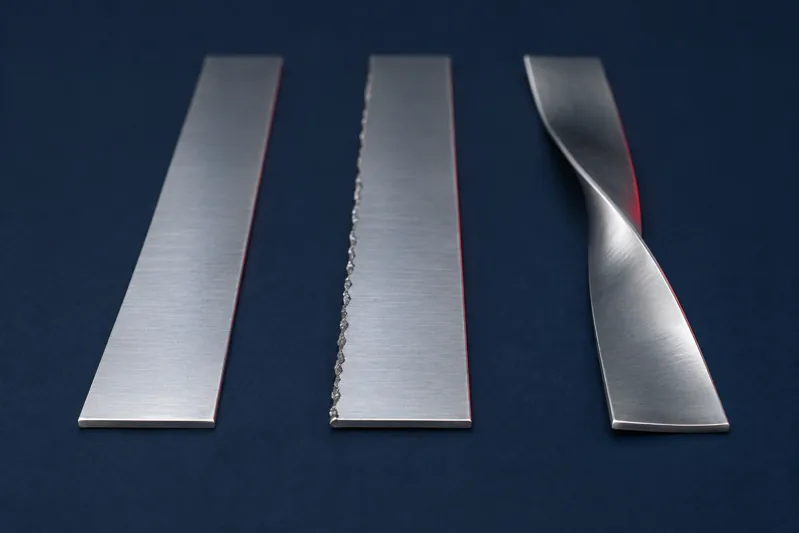
Blade gap — the single biggest cause of bad cuts
Blade gap is the clearance between upper and lower blades. Set it wrong and no other adjustment will save the cut. Critically, there is no one-size setting — the correct clearance changes with material type and thickness, because tensile strength and hardness dictate how the material fractures.
Blade gap is typically 5–10% of material thickness. Cutting 6 mm mild steel, the gap should sit roughly between 0.3 mm and 0.6 mm. Harder material generally wants the upper end of the range; softer material the lower.
| Material thickness | Approx. gap range (5–10%) |
|---|---|
| 3 mm | 0.15 – 0.30 mm |
| 6 mm | 0.30 – 0.60 mm |
| 10 mm | 0.50 – 1.00 mm |
| 16 mm | 0.80 – 1.60 mm |
| 20 mm | 1.00 – 2.00 mm |
Gap too wide and the material tears rather than shears cleanly — that produces the classic burr and edge roll-over. Gap too tight and the blades effectively collide through the material, accelerating edge wear and risking chipping.
This is also where a lot of avoidable scrap comes from in mixed-material shops: the gap gets set correctly for one job, then the next job runs a different thickness on the same setting. On a CNC shear the gap is set automatically from the programmed material, which removes the failure mode entirely. On a manual machine it is a discipline problem.
Twist and camber — look at rake angle
Rake angle is the tilt of the upper blade relative to the lower. It exists so the cut progresses across the sheet rather than shearing the entire length at once — which is what keeps required tonnage manageable.
The trade-off is distortion. Too much rake and the strip twists or bows.
- Twist — the strip corkscrews along its length. Caused by excessive rake angle. Reduce the angle.
- Camber — the strip bows sideways in-plane without twisting. Also driven by excessive rake. Reducing the angle is the primary fix; increasing ram speed and checking grain direction can help further.
Narrow strips show this worst, because there is less material width resisting the distortion. If you are cutting long thin strips and fighting bow, rake angle is the first thing to look at — not the blades.
Hold-down — the overlooked one
Hold-down pads clamp the sheet before the blade descends. If pressure is low or pads are worn, the material lifts or creeps during the cut, and you get dimensional variation that looks like a back gauge fault but isn't.
Check that pads contact evenly across the full length and that hydraulic pressure is at spec. Uneven contact across a 3 m bed will produce a cut that is accurate at one end and out at the other.
Reading blade condition
Dull blades announce themselves before they fail outright:
- Burrs appearing on material that used to cut clean
- Noticeably more effort or slower cutting
- Bowing or distortion that wasn't there before
- Increased vibration through the machine
For mild steel, resharpening is generally needed every 20–30 operating hours. High-strength material shortens that interval considerably. Sharpening before the edge fully deteriorates is the cheaper path — a badly degraded edge can damage the machine, not just the part.
Burrs are the one symptom with two very different causes — wrong gap and dull blades. Check and correct gap before you pull blades for sharpening. Gap is free to fix; a sharpening cycle costs money and downtime.
When it isn't the blades at all
Some faults sit outside the cutting zone entirely:
- Hydraulic — slow, inconsistent or juddering stroke often points to oil condition, temperature or pressure rather than tooling.
- Back gauge — repeatable length error across parts is a gauge calibration or ball screw wear issue.
- Frame and alignment — if blade gap measures correctly at both ends but the cut quality varies along the length, the issue may be blade alignment or frame condition. That is a service call, not an adjustment.
- Debris — offcuts and scale in the cutting area cause intermittent, hard-to-reproduce faults. Keep the zone clean.