Most fiber laser weld problems trace back to one of three defects: porosity, undercut, or spatter. Each has a distinct look and a distinct set of root causes — and diagnosing the right one first saves a lot of wasted parameter tweaking. This guide walks through how to identify each defect and what actually fixes it.
Porosity
Porosity appears as small round voids inside or on the surface of the weld bead — often not visible until the part is ground, cross-sectioned, or X-rayed. It's the defect most likely to slip through a visual inspection and show up later as a structural or leak problem.
Common causes:
- Contamination — oil, moisture, or surface oxides on the base metal vaporizing during welding and getting trapped in the solidifying weld pool
- Insufficient shielding gas coverage or flow rate, letting atmospheric gases interact with the molten metal
- Welding aluminum without filler wire — solidification shrinkage cracking creates gas pockets that autogenous (no-filler) welds are especially prone to
- Incorrect focus position causing keyhole instability, which traps gas as the keyhole collapses irregularly
Fix: clean the joint with acetone or another non-residue solvent before welding, confirm shielding gas flow at 15–20 L/min, and verify the focal offset matches your material thickness. On aluminum, add filler wire rather than relying on an autogenous pass.
Undercut
Undercut is a groove or thinning melted into the base metal right along the edge of the weld bead. Unlike porosity, it's visible without cutting the part open — run a finger or a straightedge along the bead edge and it's usually obvious.
Common causes:
- Travel speed too fast relative to the power setting — the beam melts the edge of the joint faster than the pool can fill back in behind it
- Beam angle or joint alignment that concentrates heat unevenly on one side of the seam
Fix: the first correction is almost always to slow travel speed slightly or reduce power to rebalance the ratio between the two. Recheck beam-to-joint alignment before making a second parameter change — a misaligned beam will keep producing undercut on one side no matter what power or speed you set.
Spatter
Spatter is small droplets of molten metal ejected onto the surface around the weld — visible immediately after welding, and often requiring cleanup or grinding before the part can move to finishing.
Common causes:
- Surface contamination vaporizing explosively as the beam passes over it
- An unstable keyhole caused by excess power relative to material thickness
- Poor shielding gas coverage, letting atmospheric interaction disrupt the melt pool surface
Fix: clean surfaces and correct gas flow before touching power or speed — contamination and gas coverage account for most spatter issues and are the fastest things to rule out.
Check contamination and shielding gas first on any defect — they're the most common root cause across all three types and the fastest to rule out. Changing power or travel speed on a joint that's still contaminated just produces a different-looking version of the same underlying problem.
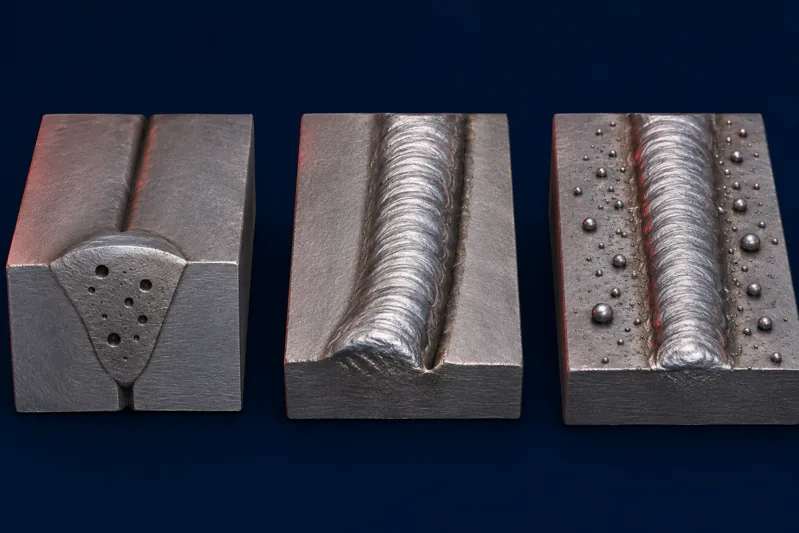
Telling the Three Apart at a Glance
| Defect | How It Looks | When You Notice It |
|---|---|---|
| Porosity | Small round voids, often internal | After grinding, cross-section, or X-ray |
| Undercut | Groove or thinning along bead edge | Immediately, visible on the surface |
| Spatter | Molten droplets around the weld | Immediately after welding |