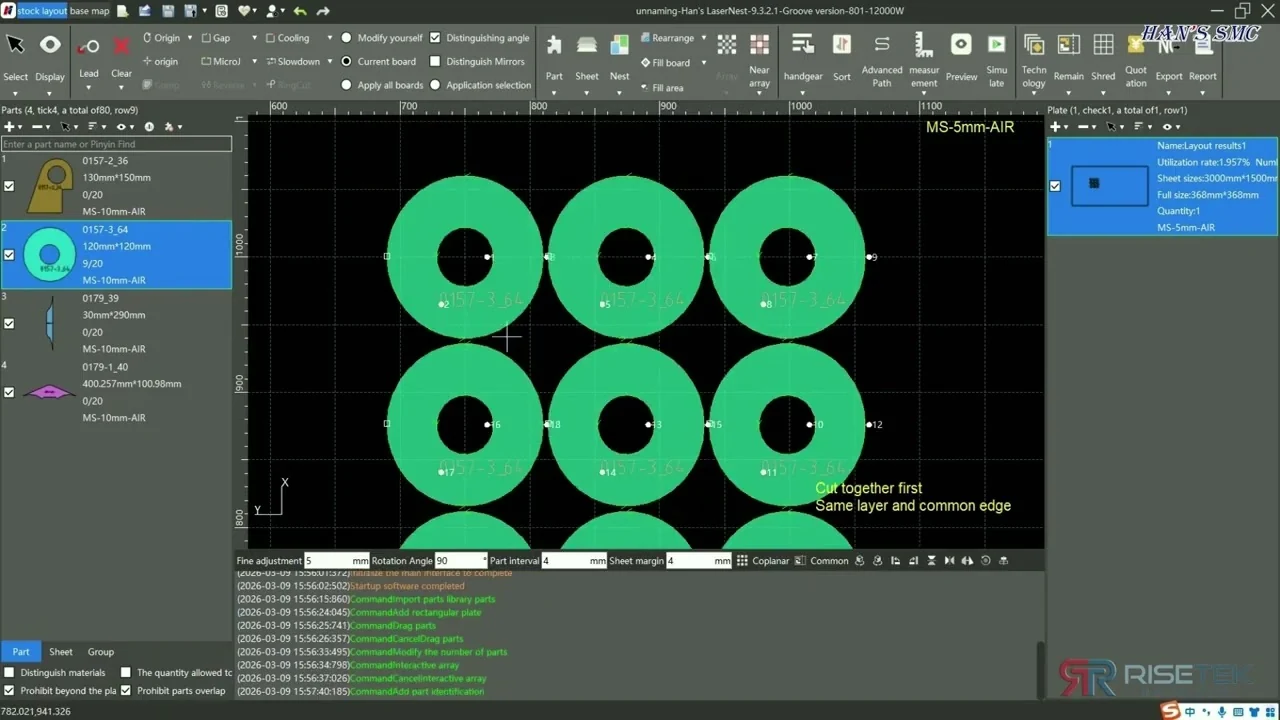
A nest of eighty parts becomes a pile of eighty parts the moment it leaves the table. This is the stage that decides how much time you lose afterwards sorting them.
3 videos5:09 totalMarking · Grouping · Special parts
A nest of eighty parts becomes a pile of eighty parts the moment it comes off the table. Marking and labelling is how they stay identifiable through deburring, forming and assembly — and it is added before cutting, not after.
Tutorial 061:56
Part Marking and Labeling
Grouping and combination
Grouping keeps related parts together through nesting and cutting. On assemblies, having every part of one weldment come off the sheet together is what stops a job stalling because one bracket is somewhere in a pile.
Tutorial 091:51
Part Grouping and Combination
Parts that need special handling
Not every part behaves the same on a nest. Special part recognition covers the ones that need treating differently rather than being processed with everything else.
Tutorial 101:22
Special Part Recognition
The downstream argument
Marking and grouping cost seconds in software and save real time in the shop. The saving does not show up on the laser — it shows up at the bench, which is why it gets skipped and why skipping it is a false economy.
Because after cutting they are loose on a table and have to be identified before they can be marked. Marking is applied as part of the cutting program, so parts arrive at the bench already identifiable.
What does part grouping do?
It keeps related parts together through nesting and cutting, so all the components of one assembly come off the sheet together rather than being distributed across several nests.
Does marking slow the job down?
It adds cycle time on the laser and saves time at the bench. On assemblies and multi-part orders the trade is usually strongly in favour of marking, which is why it is worth doing even though the cost is visible and the saving is not.
What counts as a special part?
Parts that cannot be processed on the same terms as everything else on the nest and need recognising separately. Tutorial 10 covers how the software handles them.
Is this worth doing on small jobs?
On a handful of parts you can identify by eye, no. The value scales with part count and assembly complexity, and it becomes hard to work without somewhere around the point where sorting starts costing more than marking would have.
Running a Han’s Laser machine in Canada?
Operator training is included with every machine we deliver, and our technicians support LaserNest alongside the hardware.