Every press brake purchase decision starts with one number: how many tons do you need? Get it wrong in one direction and you're buying more machine than the job requires. Get it wrong in the other and you're cracking tooling, deflecting frames, and scrapping parts on the first production run.
Tonnage calculation is not complicated, but it requires understanding a few variables — material thickness, bend length, die opening, and process type — and knowing where the safety margins are. This guide covers the formula, quick reference tables for the most common materials, two worked examples, and the capacity rules that protect your machine and your tooling.
The Air Bending Tonnage Formula
The overwhelming majority of CNC press brake work is done in air bend mode — where the punch penetrates the die opening to a programmed depth, forming the angle without bottoming out against the die walls. The air bending tonnage formula is:
t = material thickness (mm)
L = bend length (meters)
V = die opening width (mm)
60 = constant for mild steel (tensile strength ~400 N/mm²)
The constant 60 is calibrated for mild steel with a tensile strength of approximately 400 N/mm². For other materials, you multiply the result by a correction factor covered in the next section.
The Die Opening Rule
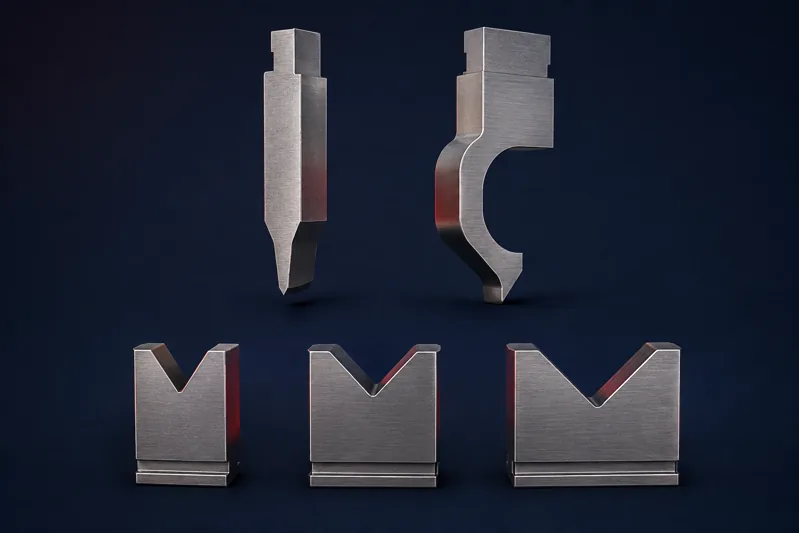
The die opening V is the width of the V-die slot. The standard rule for air bending is: V = 8 × material thickness. For 3mm mild steel, use a 24mm die. For 6mm plate, use a 48mm die.
Going narrower than 8× the thickness increases tonnage requirements significantly and can mark the part surface. Going wider produces a larger inside bend radius, which may not meet drawing tolerances. The 8× rule is the starting point — confirm with your tooling supplier for specific materials.
Substituting V = 8t into the tonnage formula simplifies it to a quick mental calculation:
This version is fast enough to run in your head. 4mm mild steel at 2 meters: 7.5 × 4 × 2 = 60 tons. For other materials, multiply by the correction factor below.
Quick Reference: Mild Steel Tonnage by Thickness
The table below gives air bending tonnage per meter of bend length for mild steel, using the standard 8× die opening for each thickness.
| Thickness | Recommended V-die | Tons per meter | Tons for 2m bend | Tons for 3m bend |
|---|---|---|---|---|
| 1 mm | 8 mm | 7.5 t/m | 15 t | 22.5 t |
| 2 mm | 16 mm | 15 t/m | 30 t | 45 t |
| 3 mm | 24 mm | 22.5 t/m | 45 t | 67.5 t |
| 4 mm | 32 mm | 30 t/m | 60 t | 90 t |
| 5 mm | 40 mm | 37.5 t/m | 75 t | 112.5 t |
| 6 mm | 48 mm | 45 t/m | 90 t | 135 t |
| 8 mm | 64 mm | 60 t/m | 120 t | 180 t |
| 10 mm | 80 mm | 75 t/m | 150 t | 225 t |
| 12 mm | 96 mm | 90 t/m | 180 t | 270 t |
These are calculated requirements. Apply the 80% safety rule (explained below) when choosing a machine — divide the calculated tonnage by 0.80 to get the minimum recommended machine rating.
Material Correction Factors
The base formula uses the constant 60, which reflects mild steel. Every other common sheet metal material requires a correction multiplier applied to the mild steel result.
| Material | Correction Factor | Notes |
|---|---|---|
| Mild steel (A36, A572) | 1.0 (base) | ~400 N/mm² tensile strength |
| 304 / 316 Stainless steel | 1.5 – 1.7 | Higher UTS + pronounced work hardening; use 1.7 for conservative sizing |
| Duplex stainless | 1.8 – 2.2 | Very high yield strength; machine sizing requires manufacturer confirmation |
| 5052 / 6061 Aluminum | 0.5 – 0.65 | Much lower UTS; 5052 is at the lower end, 6061-T6 closer to 0.65 |
| Copper / Brass | 0.5 – 0.7 | Varies significantly by alloy and temper |
| High-strength / HSLA steel | 1.5 – 2.0 | A514, Hardox, AR400; use actual UTS/400 as the correction factor |
| Galvanized / pre-coated steel | 1.0 – 1.1 | Same as mild steel base; thin coating has negligible tonnage effect |
Calculate the mild steel tonnage first using T = 7.5 × t × L, then multiply by the correction factor. For 3mm 304 stainless at 2 meters: 7.5 × 3 × 2 = 45 tons (mild steel) × 1.7 = 76.5 tons required. The 80% capacity rule then pushes machine sizing to at least 95 tons.
Air Bending vs Bottom Bending vs Coining
The formula above is for air bending. The other two bending processes require dramatically more force and use a different machine sizing approach.
| Process | Tonnage Multiple (vs air bend) | When it's used |
|---|---|---|
| Air bending | 1× (baseline) | Standard CNC press brake production; angle controlled by punch depth |
| Bottom bending (bottoming) | 3 – 5× | Removes springback by driving material into die; needed for tight-tolerance angle consistency on high-springback materials |
| Coining | 5 – 8× | Full plastic deformation of the bend zone; eliminates springback completely; rarely used on modern servo-CNC machines |
If any of your production work requires bottom bending, size the machine on the bottoming tonnage, not the air bending figure. Running a bottoming sequence on a machine sized only for air bending will overload the frame.
Worked Example 1: 4mm Mild Steel, 2-Meter Bend
Scenario: 4mm A36 mild steel, 2,000mm bend length, air bend mode
Worked Example 2: 3mm Stainless Steel, 1.5-Meter Bend
Scenario: 3mm 304 stainless steel, 1,500mm bend length, air bend mode
The 80% Capacity Rule
Never plan production at the full rated tonnage of the machine. The standard practice is to stay within 80% of rated capacity, leaving a 20% margin for real-world variables:
- Material tolerance variation — sheet metal thickness is specified to a tolerance, not an exact value. A coil labelled 4mm may run 4.2mm at the heavy end of tolerance, which increases tonnage requirements by ~10%.
- Hardness variation — mill-certified material has a tensile strength range, not a fixed value. A batch of A36 can run from 400 to 550 N/mm².
- Tool wear — a worn punch tip with a larger radius requires more tonnage to achieve the same bend depth.
- Process variation — back pressure, material grain direction, and bend angle all introduce variability that can push required tonnage above the calculated value.
To apply the rule: take your calculated tonnage and divide by 0.80. That result is the minimum machine rating you should purchase.
If the calculation gives 90 tons, you need at least a 112-ton machine. Rounding up to the next standard size (typically 125 tons) gives you meaningful operating headroom throughout the machine's service life.
Off-Center Bending
The tonnage rating on a press brake nameplate assumes the load is applied in the center of the bed. When you bend a short part positioned toward one end of the machine, the load distribution between the two cylinders becomes unequal, and the effective capacity drops.
Most press brake manufacturers limit off-center loads to 10–15% of rated capacity per side. For a 100-ton machine with a 3-meter bed, bending a 500mm part at the far end of the bed may be limited to 30–40 tons effective capacity — not 100 tons. Check your machine's off-center capacity table in the operator manual before running short-part production at the ends of a long bed.
Shops frequently exceed off-center capacity limits when bending short flanges, brackets, or prototype parts on a large-bed machine without checking the side-load table. The machine does not stop you — but the ram will visibly tilt, angle consistency degrades, and repeated overload damages the guide system over time.
When to Step Up Tonnage Class
Beyond the calculated minimum, there are several reasons to size up to the next machine class:
- You process mixed materials. If your shop bends both mild steel and stainless steel, size for the stainless — the stainless requirement is always higher.
- You plan to add automation. Robot-tended press brake cells require the machine to operate at consistent, conservative tonnage settings. Extra headroom makes the process more stable.
- Your customer base is growing. A machine sized at the 80% boundary today will be at 95% in three years when your material mix thickens. The cost difference between a 135-ton and 175-ton machine is far smaller than replacing the machine in five years.
- You bend thick stainless or high-strength plate. These materials push tonnage requirements to the top of the machine's range and leave you with no margin for process variation.
What This Means for Machine Selection
Press brakes are sold in standard tonnage steps: 40, 60, 80, 100, 135, 175, 220, 300, 400, 500, 600+ tons. Bed lengths typically run 2.5m, 3m, 3.6m, and 4m. After running your tonnage calculation and applying the 80% rule, round up to the next standard step.
Rise Tek carries the full Dener and Haco EuroMaster S press brake lineup from 40 to 600+ tons with 2.5m to 6m bed lengths. The Dener range includes hydraulic, servo-electric (belt-drive, up to 200 tons), and ball screw models — each suited to different production profiles. See our comparison post if you haven't yet worked through the hydraulic vs servo-electric drive decision.
▶