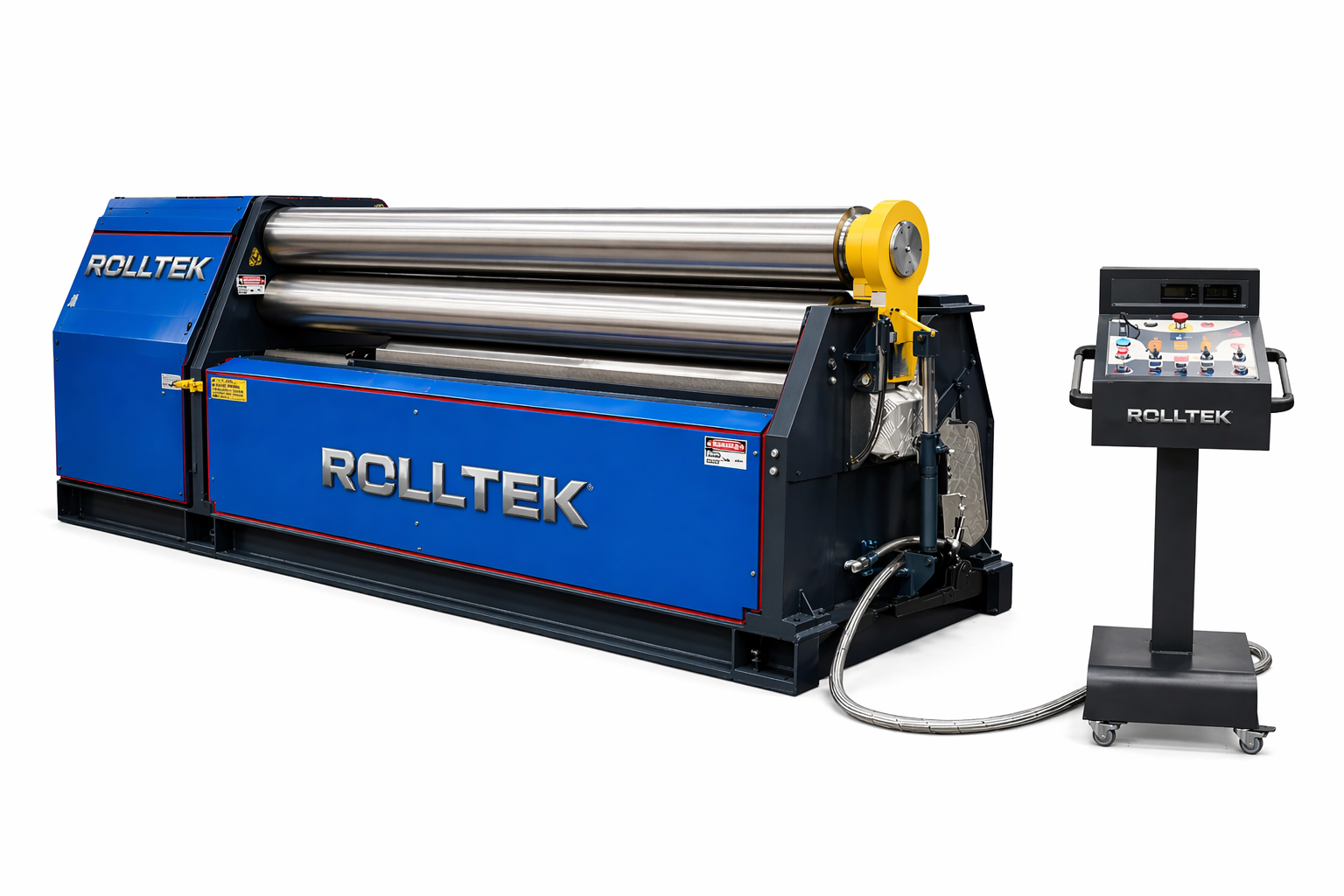
Before an angle roll bends anything, the tooling has to match two things: the axis you're bending around, and the exact shape of the profile going through the rolls. Get either one wrong and the result is a section that buckles, flattens, or curves unevenly — regardless of how good the machine is. This guide covers both.
Easy-Way vs Hard-Way Bending
Every structural profile has a strong axis and a weak axis. Easy-way bending curves the profile around its weak axis — the orientation that offers less resistance, so it takes less force to bend and generally produces a cleaner result on tighter radii. Hard-way bending curves the same profile around its strong axis, which takes significantly more force and carries a real risk of local buckling or distortion if the tooling doesn't properly support the section through the bend.
Neither orientation is universally "correct" — which one you need depends entirely on how the leg or flange has to face in the finished part. Easy-way is more common because it's less demanding on both the machine and the material, but hard-way bending is a normal, necessary setup whenever the application calls for that specific orientation.
| Factor | Easy-Way | Hard-Way |
|---|---|---|
| Bending axis | Weak axis | Strong axis |
| Force required | Lower | Significantly higher |
| Risk of distortion | Lower | Higher if tooling doesn't properly support the section |
| When it's used | Whenever the leg orientation allows it | When the application specifically requires it |
Why Tooling Has to Match the Profile
Angle rolls use interchangeable die and roll inserts shaped to match the cross-section being bent. An insert cut for angle iron won't properly grip and support a round tube, and a tube insert won't do the job on a wide-flange beam — the contact geometry between the insert and the profile is what keeps the section from collapsing or twisting as force is applied.
- Angle iron (L-profile) — inserts supporting both legs, set up for either easy-way or hard-way depending on the orientation needed
- Flat bar — flat-faced inserts sized to the bar's width and thickness
- Square and rectangular hollow section (HSS) — inserts contoured to prevent the walls from caving in under roll pressure
- Round tube and pipe — grooved inserts matched to the outside diameter
- C-channel — inserts supporting the web and both flanges to prevent flange spread
- I-beam / W-beam (wide flange) — inserts supporting the web independently from the flanges, since the two elements resist bending differently
If a bend comes out with flat spots, local buckling, or an inconsistent curve, confirm the tooling insert actually matches the exact profile and orientation before adjusting anything else. A mismatched insert produces exactly these symptoms, and no amount of roll pressure adjustment fixes a tooling mismatch.
Section Types an Angle Roll Can Handle
With the correct tooling, angle rolls bend a wide range of structural sections: W-beam (wide flange), L-angle, T-sections, S-beam, C-channel, square and rectangular bar, hollow structural sections, tubes, pipes, and round bar. Each of these needs its own matched insert or die setup — there's no universal tooling that handles every profile type equally well.
📘