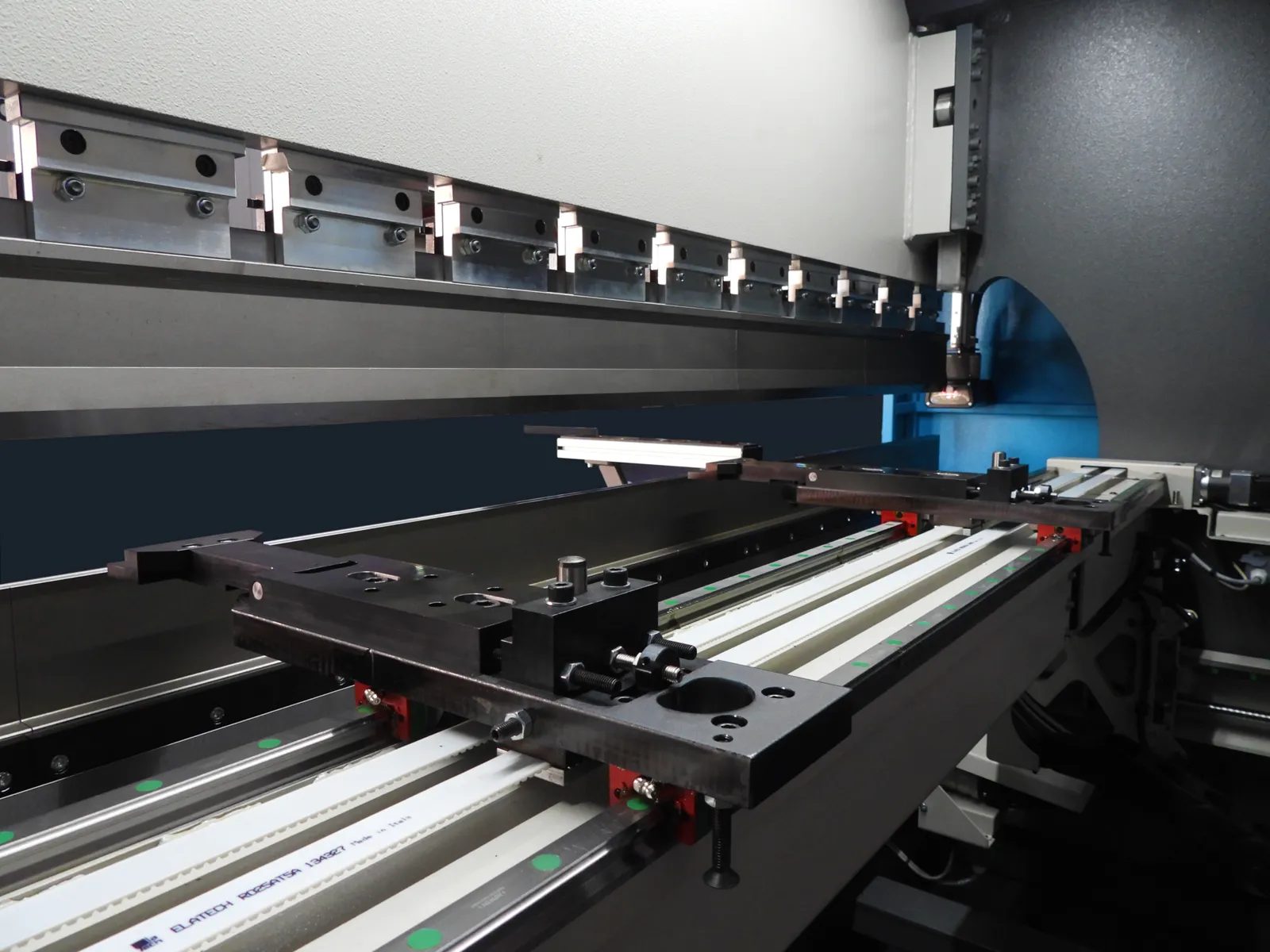
A CNC press brake applies enormous force to a small point of operation, which is exactly why point-of-operation guarding, safe procedure, and provincial compliance aren't optional extras — they're the baseline for running the machine at all. This guide covers the practical safety systems and procedures every Canadian shop needs in place, and the compliance framework they sit under.
This guide is an educational resource, not a safety certification or legal compliance document. Always follow your machine manufacturer's safety manual, applicable Canadian OHS regulations, and consult a qualified health and safety professional for your specific workplace. Rise Tek is not liable for safety decisions made based solely on this content.
Point-of-Operation Guarding
The point of operation on a press brake — where the punch meets the die — is where hands must never be while the ram is in motion. Modern CNC press brakes use one or more of the following guarding methods to enforce this:
- Light curtains — an invisible infrared beam barrier across the danger zone in front of the tooling. If the beam is broken while the ram is descending, the machine stops immediately. This is the most common standard safety system on modern CNC press brakes.
- Laser area scanners — a more flexible alternative to a fixed light curtain, capable of monitoring an irregular protected zone rather than a straight beam line. Often specified as an upgrade over a standard light curtain.
- Physical guards — fixed or movable barriers that physically prevent hand access to the danger zone, sometimes used alongside a light curtain rather than instead of one.
Whatever system is installed, it must be functional and verified before every shift. Never bypass, tape over, or defeat a light curtain sensor — doing so disables the primary point-of-operation safeguard and is one of the most common root causes of serious press brake injuries.
Safe Hand Placement Zones
Hands must never be within the closing zone between punch and die while the ram is in motion. Operators should hold the workpiece from the sides, never underneath the path of the ram, and should position themselves so that no part of the body enters the guarded zone during the bend cycle. Point-of-operation guards must be in place and functional before operating — this isn't a judgment call to be made bend-by-bend.
Lockout/Tagout (LOTO)
LOTO is the procedure for de-energizing a machine before performing maintenance, tooling changes, or clearing a jam. It exists to prevent the machine from being re-energized or moving while someone has their hands inside it. The standard steps are:
- Notify affected personnel that the machine is being taken out of service.
- Shut down the machine using its normal stopping procedure.
- Isolate all energy sources — electrical supply, hydraulic pressure, and pneumatic supply.
- Apply a personal lockout padlock at each isolation point.
- Verify zero-energy state by attempting to start the machine (it should not start).
- Perform the maintenance or tooling change.
Never perform maintenance on an energized press brake or fiber laser without LOTO. Skipping this step is one of the most common causes of serious fabrication shop injuries, precisely because it's the step people are most tempted to skip for a "quick" adjustment.
Canadian Compliance Framework
CNC press brakes in Canadian workplaces must comply with CSA Z142 (Code for Power Press Operation) along with provincial occupational health and safety regulations. Key requirements include:
- Guarding the point of operation (light curtains, scanners, or physical guards)
- Operator training and certification before independent operation
- Lockout/tagout procedures for maintenance and tooling changes
- Documented safe work procedures
Provincial authorities each have their own specific press operation rules on top of the CSA baseline — Ontario operates under OHSA, Alberta under the OHS Act, and BC under WorkSafeBC. Consult your provincial authority directly for jurisdiction-specific requirements, since provincial rules can be more detailed than the national CSA code.
Operator Training
Canadian OHS regulations require employers to ensure workers are competent before operating hazardous equipment — a CNC press brake qualifies. Training should cover machine controls, the specific safety systems installed on that machine, interlock testing, basic maintenance boundaries (what an operator can and cannot do without LOTO), and emergency stop procedures. Document all training with signed records; if an incident ever occurs, undocumented training is functionally the same as no training from a compliance standpoint.
🛡️Common Safety Mistakes
- Bypassing or taping over light curtains — almost always done to save a few seconds per cycle, and almost always the root cause when an incident is investigated.
- Skipping LOTO for "quick" adjustments — the length of the task doesn't change the energy state of the machine; a five-second jam clear still needs LOTO.
- Treating training as a one-time event — new tooling, new controls, or a new operator role all warrant refresher training, not just the initial onboarding.
- Assuming CSA Z142 is the only requirement — provincial OHS rules apply on top of the national code and can be more specific to your operation.
Related Reading
- Press Brake Safety Features: What to Look for Before You Buy
- Fiber Laser Safety: Classifications, PPE, Fume Extraction & Interlocks
- What is a CNC Press Brake? Complete Guide for Canadian Fabricators
- Machine Safety Guides — Education Center
- CNC Press Brakes at Rise Tek — Hydraulic, Servo-Electric & Ball Screw