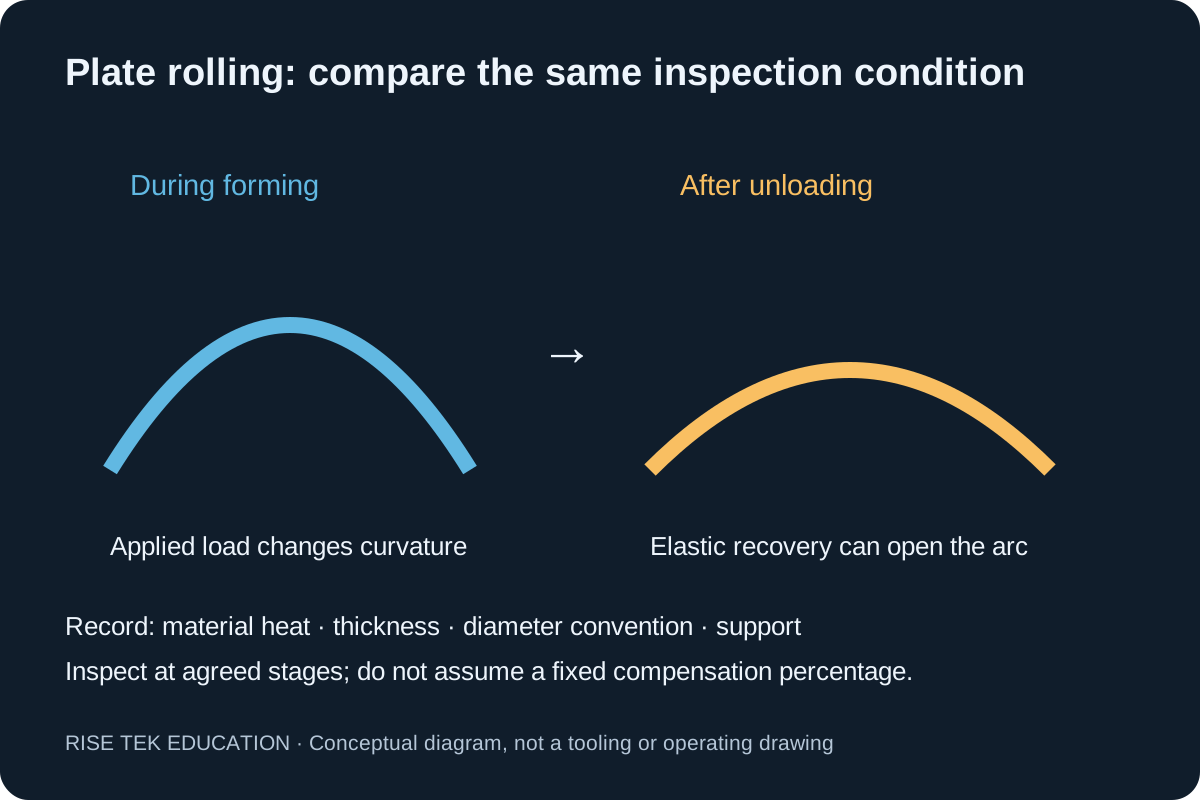
Plate rolling springback is the elastic recovery that occurs as forming load is released. The plate can open to a larger radius than it had under load. A cylinder that appears correct in the machine may therefore measure differently after unloading. That change should be distinguished from local end flats, ovality and distortion caused by handling or welding.
For Canadian shops comparing RollTek plate rolls, the practical question is how the proposed process produces an acceptable unloaded part across the material batches you expect to use. There is no universal compensation percentage that applies to every grade, width, thickness, diameter and machine.
What affects the result?
Material properties and forming geometry influence elastic recovery. Grade, condition and batch variation matter alongside actual thickness and the target curvature. Machine settings that work for one material lot may need review for another, even when the nominal drawing dimensions are unchanged.
Keep capacity separate from compensation. A machine must first be rated for the actual material, width, thickness and required diameter, including the end pre-bending requirement. Adding passes or changing settings is not permission to exceed that rating. Read the plate-roll capacity guide before evaluating a sample.
Springback, ovality or an end flat?
| Observation | What to record | What to review |
|---|---|---|
| The arc opens after unloading | Before/after stage, material and support condition | Elastic recovery and the approved compensation method |
| Diameter changes around the circumference | Several agreed measurement directions and axial locations | Roundness, support condition and the forming result |
| A straight portion remains near the seam | End-flat length and local curvature at each end | Pre-bending capability and end-preparation requirements |
| Shape changes after tack-up or welding | Measurements at each fabrication stage | Fit-up, restraint and the welding process |
These observations can occur together. Do not diagnose every diameter error as springback. A flexible shell can change shape under its own weight, and a measurement taken while restrained is not directly comparable with an unrestrained measurement. Agree how the part is supported during inspection.
Specify the measurement condition
State whether the drawing requires inside diameter, outside diameter or another reference. Define where along the shell measurements are taken and whether the seam is open, tacked or welded. Keep the support arrangement and inspection method consistent between the trial and production.
A circumference measurement can help assess overall size, but does not by itself establish roundness. Two shells can have similar circumference and different local shape. Agree suitable measurements for your tolerance and record both the overall dimension and any local issues near the seam.
A repeat-job record that helps the next batch
Record the drawing revision, material grade and heat or batch, actual plate dimensions, machine identification, tooling or roll configuration, supports and the approved program revision. Capture the unloaded result before accepting the settings for repeat work.
For example, if a shell requires 1,000 mm outside diameter, specify the drawing tolerance and agreed support condition with that dimension. If the unloaded sample measures larger, record the result and have the trained operator review the approved process. The difference is not automatically a direct roll-position correction or proof that the machine lacks capacity.
On the next batch, inspect the first part again instead of assuming that the saved program guarantees the same result. Keep any change traceable to a new program revision and material record. Changes to machine settings must follow the machine manual and trained operator’s procedure.
Does CNC eliminate springback?
No. A control can store or execute settings and may offer correction functions, but its exact capabilities depend on the supplied configuration. Ask the supplier to demonstrate how a first part is checked, how corrections are approved and what happens when the material batch changes. Do not assume automatic diameter measurement or closed-loop compensation is included.
Compare complete cycles, including setup and inspection, when deciding whether automation suits your workload. Ask for representative unloaded samples and documented tolerances rather than relying on a fixed throughput promise. The sample-acceptance guide provides a broader purchasing review.
Prepare your next rolling trial
Download the blank repeat-job record and agree the measurement stages before a demonstration. For the machine layouts and rating terms, see RollTek plate-rolling basics. For an equipment comparison, use our 3-roll versus 4-roll Canadian buyer guide.
Planning a tapered shell? Use the cone-rolling application checklist to define geometry, accessories and supplier-confirmed capacity.
Check these out
Send your drawing for a model-specific application review.
Frequently asked questions
Why does a rolled plate open after unloading?
Elastic recovery can increase the radius after forming load is released. Compare the same material, inspection stage and support condition before attributing a dimensional change to springback.
Is there a fixed plate-rolling springback percentage?
No universal percentage is suitable for every job. Confirm the actual material, geometry and machine configuration, then evaluate representative unloaded samples.
Does CNC plate rolling eliminate springback?
No. Confirm the supplied control and measurement functions. Stored settings do not remove material variation or the need for first-part inspection.
Does a correct circumference prove a shell is round?
No. Overall circumference does not establish local roundness. Agree additional measurements and a consistent support condition for the required tolerance.