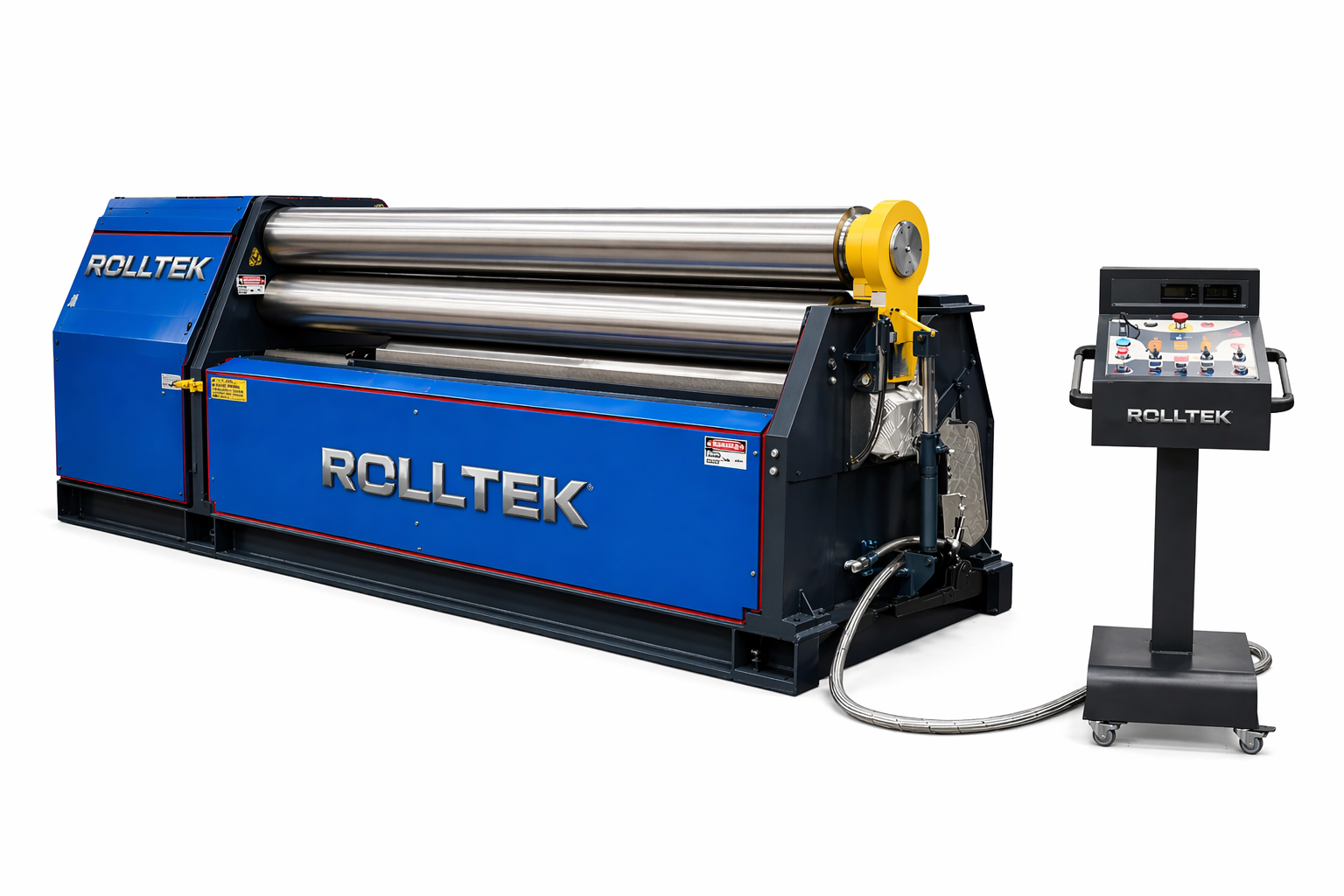
Both 3-roll and 4-roll plate rolling machines produce properly pre-bent, round cylinders — the difference isn't final part quality, it's process and throughput. Here's how to figure out which configuration actually matches your shop's production volume.
The Process Difference
A 3-roll (initial pinch) machine pre-bends one end of the plate, then the operator removes the plate, flips it end-for-end, reloads it, and pre-bends the second end before the main rolling passes begin. A 4-roll machine adds an extra pinching roll that holds the plate square through the entire cycle, pre-bending both ends in a single continuous pass with no flipping or repositioning required.
| Factor | 3-Roll (Initial Pinch) | 4-Roll |
|---|---|---|
| Up-front investment | Lower | Higher |
| Pre-bending process | Flip and reload between ends | Single pass, no flipping |
| Throughput | Baseline | 40–60% increase over manual 3-roll operation |
| Conical bending | Standard | Standard |
| Best fit | Mixed-use, lower-volume shops | High-production, repetitive-part shops |
Where 3-Roll Wins
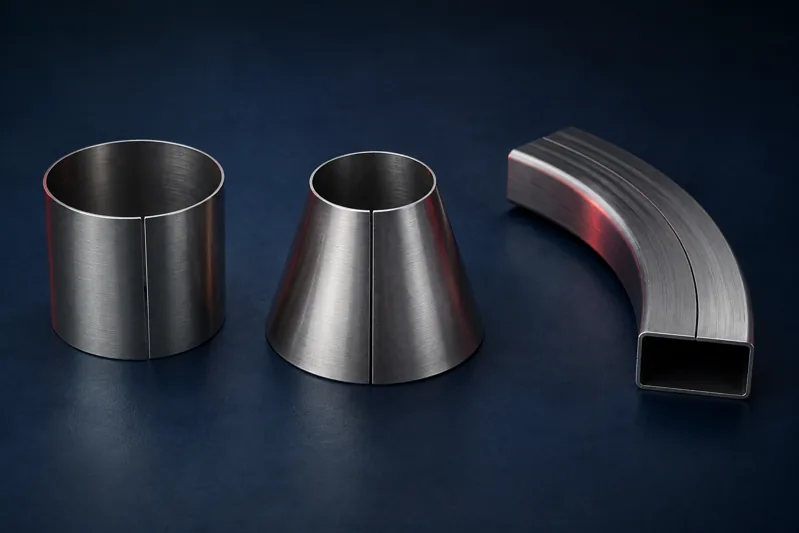
A 3-roll initial pinch machine is a lower up-front investment while still offering full bending versatility, including conical bending for cones and transitions. For shops running a mixed job list — some rolling, some other fabrication work — where cylinder rolling isn't the dominant, repetitive task, the flip-and-reload step simply isn't a meaningful bottleneck. The lower investment is the better use of capital.
Where 4-Roll Wins
Eliminating the flip-and-reload step delivers a 40–60% throughput increase over manual 3-roll operation, with a typical 18–24 month ROI window for high-production shops. The single-pass pre-bend also produces more consistent, parallel edges — which matters directly for shops doing pressure vessel work, since ASME Section VIII tolerances benefit from that consistency and support automated circumferential welding without manual fit-up correction.
If your shop rolls the same cylinder diameter repeatedly at real volume, the 4-roll's throughput advantage compounds fast. If rolling is one task among many, that advantage rarely gets exercised often enough to justify the higher investment.
The Volume Signal
There's no fixed part-count threshold that tells you to upgrade — it depends on how much of your shop's capacity is tied up in the flip-and-reload step specifically. A useful gut-check: estimate how many cylinder-rolling jobs your shop runs per month, and how many of those are repeat diameters rather than one-off custom work. High repeat volume is where the 4-roll's single-pass pre-bend pays for itself fastest. Low-volume or highly varied work rarely reaches that payback window.
📘