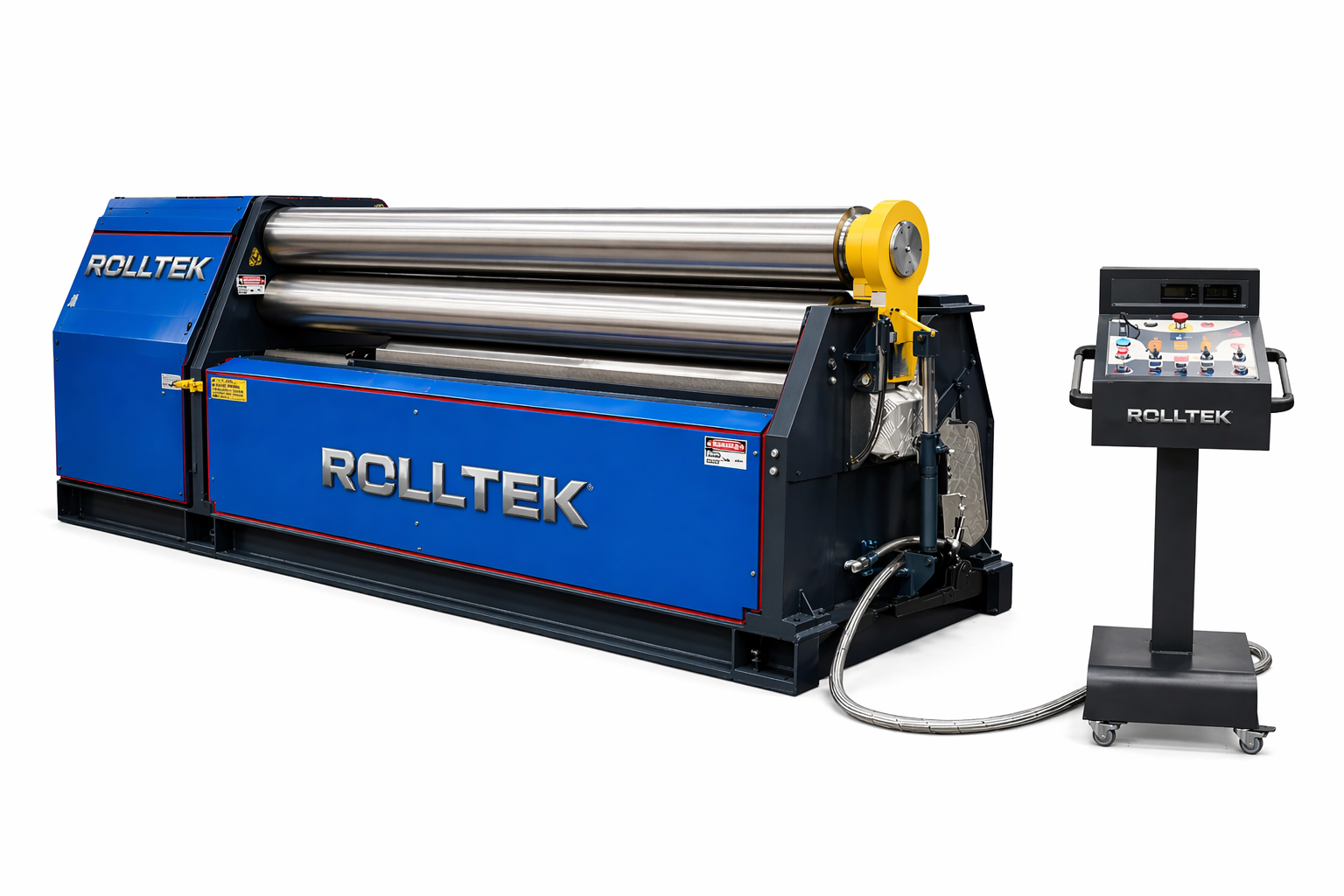
A true cylinder needs consistent curvature all the way to both edges of the plate — which is exactly the part a rolling machine can't do without help. Understanding why flat ends happen, and how pre-bending fixes it, is the difference between a clean rolled shell and a part that gets rejected at inspection.
Why Plates Roll Flat at the Ends
A plate roll forms metal by passing it between rolls arranged to apply continuous curvature. But the leading and trailing edges of the plate sit outside the points of roll contact until they've been drawn far enough into the machine — which means, on a straight pass with no preparation, both ends come out flat while the middle of the plate curves correctly. This is the single most common defect in plate rolling, and it's almost always a process step that was skipped rather than a machine or material problem.
Pre-Bending: The Step That Fixes It
Pre-bending (sometimes called crimping) is a dedicated first pass that curves each end of the plate to the target radius before the main rolling passes begin. Done correctly, it eliminates the flat sections entirely and produces a constant radius from edge to edge.
How pre-bending is executed depends on the machine's roll configuration:
- 3-roll (initial pinch) machines pre-bend one end of the plate, then the operator removes the plate, flips it end-for-end, reloads it, and pre-bends the other end before the main rolling passes. This flip-and-reload step is a normal part of the 3-roll process, not an error — but it does add handling time per part.
- 4-roll machines use an additional pinching roll that holds the plate square throughout the cycle, pre-bending both ends in a single continuous pass with no flipping or repositioning required.
3-roll and 4-roll machines both produce a properly pre-bent cylinder — the difference is process, not final quality. 3-roll requires a flip-and-reload step between the two pre-bend passes; 4-roll eliminates it by holding the plate square with a dedicated pinching roll. For high-volume production, that difference compounds into a meaningful throughput gap.
The Rolling Cycle, Step by Step
- Square and position the plate against the back gauge or roll set.
- Pre-bend the leading edge to the target radius.
- On 3-roll machines, flip the plate end-for-end and pre-bend the trailing edge. On 4-roll machines, both ends are pre-bent in the same pass.
- Run the main rolling passes, gradually closing roll pressure until the target diameter is reached.
- Check roundness at multiple points before releasing the part.
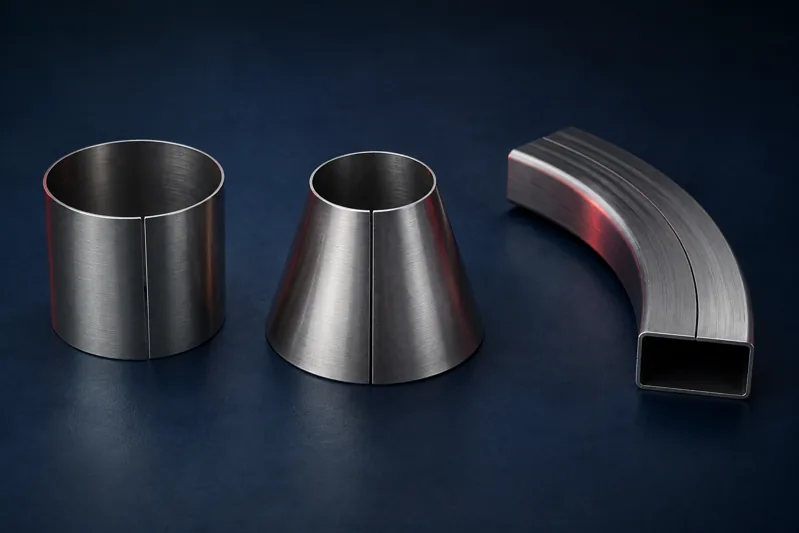
Checking Roundness Before It Leaves the Shop
Catching an out-of-round cylinder on the machine is far cheaper than catching it during weld fit-up. Use an internal or external diameter gauge, a rolled-radius template held against the shell at several points around the circumference, or a taut string/tape measurement across the diameter at both ends and the middle. Checking multiple points matters — a cylinder can measure correctly at the center and still be out of round near the edges if pre-bending was inconsistent.
Common Defects and Their Causes
| Defect | Typical Cause |
|---|---|
| Flat sections at either end | Pre-bending skipped or insufficient |
| Barrel or football shape | Uneven pressure across plate width, roll parallelism, or inconsistent side-roll positioning |
| Out-of-round at seam | Inconsistent pre-bend radius between the two ends (common on 3-roll if the flip/reload isn't precisely repeated) |
| Spiral or helical drift | Uneven feed rate or roll misalignment along the length of the pass |