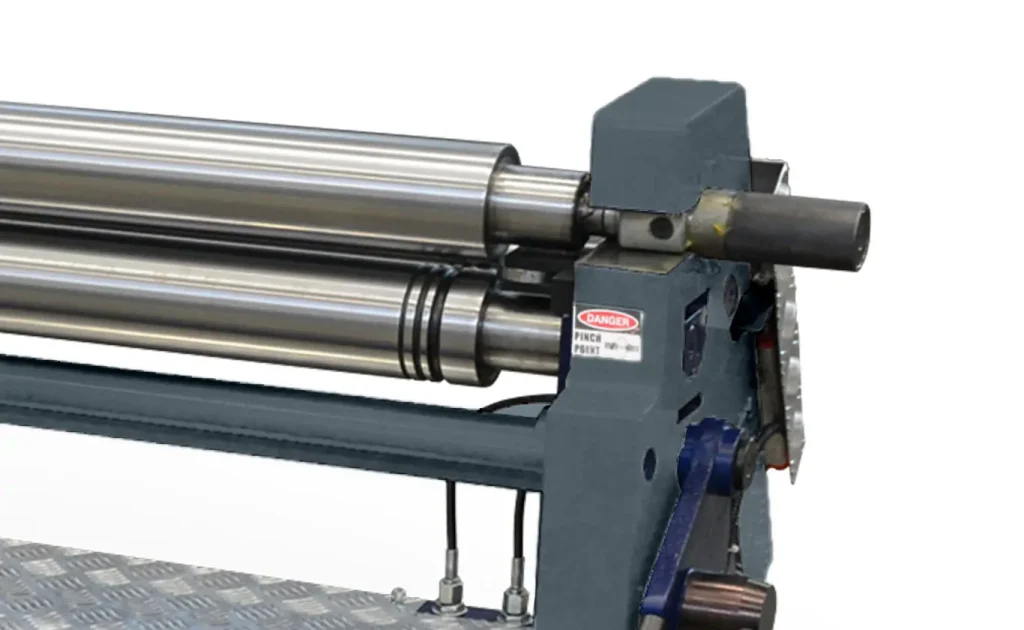
A cylinder rolled on a plate roll has a constant radius from end to end — every roll stays parallel, every pass tightens the curve evenly. A cone breaks that symmetry on purpose. Conical bending is the technique that lets a plate roll produce a taper instead of a straight cylinder, and it comes down to one deliberate change: tilting a roll instead of keeping it parallel.
What Makes Conical Bending Different
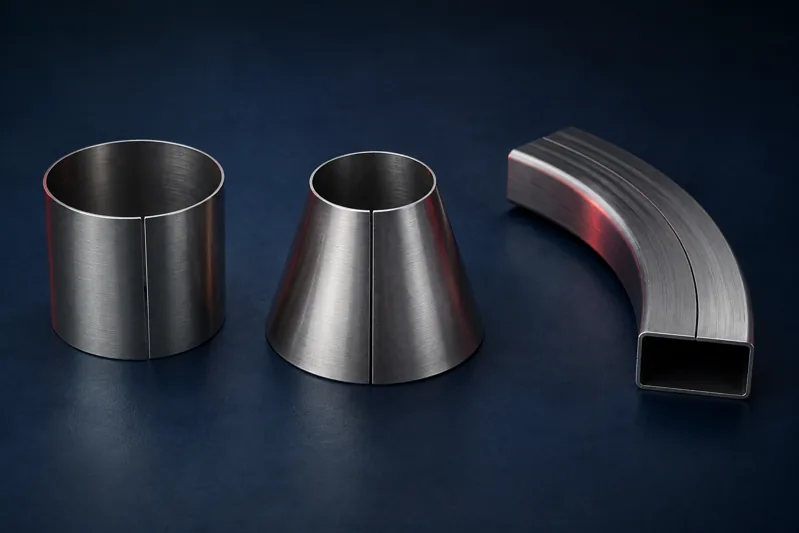
Standard cylinder rolling holds the top, bottom, and side rolls parallel to each other, so the plate curves at the same radius all the way along its length. Conical bending tilts one roll — typically a side roll — relative to the others, so the pinch point varies continuously from one end of the plate to the other. One end gets rolled tighter than the other, and the result is a taper: a cone frustum instead of a cylinder.
This is why conical bending is treated as its own setup on a plate roll rather than just "cylinder rolling with a different number." The tilt angle has to be set deliberately and held consistently through the pass — drift partway through the pass is the most common cause of a cone that comes out correct at one end and wrong at the other.
Blank Layout: Getting the Flat Pattern Right First
A cone frustum can't be cut as a plain rectangle the way a cylinder blank can. Its developed (flattened) pattern is a curved, tapered shape derived from the cone's top diameter, bottom diameter, and slant height — a standard sheet metal layout problem, typically solved with CAD/nesting software rather than worked out by hand on the shop floor.
Getting this blank layout right matters as much as the rolling setup itself: an incorrectly developed blank produces a cone that's out of round, or one where the seam edges don't align and close cleanly at both ends. If a rolled cone doesn't close evenly, the first thing to check is the blank development, not the roll tilt.
Cone rolling issues generally trace back to one of two independent problems: an incorrectly developed blank (the flat pattern was wrong before rolling even started) or roll tilt that drifted during the pass. Diagnose them separately — re-checking the blank development first rules out the cheaper, more common cause before you start second-guessing machine setup.
Common Applications
- Storage tank heads — tapered transitions on cylindrical tank shells
- Pressure vessel reducers — connecting sections of different diameter in process piping and vessels
- Wind tower transitions — tapered cans in wind tower sections, often at large diameter and heavy plate thickness
Machine Capability
Conical bending is standard equipment on both 3-roll and 4-roll plate rolling machines — it's not a feature reserved for one configuration over the other. RollTek's VERTEX (3-roll) and TITAN (4-roll) series both include tilting side rolls and auxiliary conical bending parts as standard, and some tiers add joystick-controlled positioning specifically to make cone setup faster and more repeatable than a manual tilt adjustment.
📘Quality Checks Before It Leaves the Machine
- Check the diameter at both ends against the drawing
- Confirm the taper is consistent along the length — no flat spots or sudden angle changes
- Verify the seam edges align and close evenly at both ends before welding
A cone that's correct at one end but off at the other almost always points to roll tilt drifting partway through the pass rather than a one-time setup error — worth checking mid-pass on repeat production runs, not just at the start.
Related Reading
- Plate Roll Blank Size Calculator — free tool
- How to Roll a Perfect Cylinder: 3-Roll & 4-Roll Technique Guide
- 3-Roll vs 4-Roll Plate Rolling Machines: Which One Does Your Shop Need?
- VERTEX Series 3-Roll Plate Rolls
- TITAN Series Hydraulic 4-Roll Plate Rolls
- Bending & Rolling Machine Guides — Education Center